
 |
 |
 |
 |
 |
 |
 |
 |
 |
 |

| . |  |
. |

Santa Barbara CA (SPX) Feb 04, 2011 NASA's Kepler mission has discovered its first Earth-size planet candidates and its first candidates in the habitable zone, a region where liquid water could exist on a planet's surface. UC Santa Barbara scientists are involved in the mission. Five of the potential planets are near Earth-size, and they orbit in the habitable zone of smaller, cooler stars than our Sun. Kepler, a space telescope, also found six confirmed planets orbiting a Sun-like star, Kepler-11. This is the largest group of transiting planets orbiting a single star yet discovered outside our solar system. Kepler looks for planet signatures by measuring tiny decreases in the brightness of stars caused by planets crossing in front of them. This is known as a transit. Since transits of planets in the habitable zone of Sun-like stars occur about once a year and require three transits for verification, it is expected to take three years to locate and verify Earth-size planets orbiting Sun-like stars. Two UCSB astronomers from the Department of Physics - Tim Brown and Avi Shporer - are involved in the mission. Both are also scientists at the UCSB-affiliated Las Cumbres Observatory Global Telescope (LCOGT), which Brown directs. Brown is a Kepler co-investigator, and has had a significant role in the project from the beginning in the early 1990's. Among his many contributions is the Kepler Input Catalog, a listing of about 156,000 Sun-like stars that Kepler monitors, among the millions of stars in the Kepler field. Candidate planets require follow-up observations to verify they are actual planets, and Shporer is using LCOGT telescopes for that purpose as part of a large effort carried out by the Kepler science team. His work involves several ground-based telescopes and the Spitzer Space Telescope. The star field that Kepler observes in the constellations Cygnus and Lyra can only be seen from ground-based observatories in spring through early fall. The data from these other observations help determine which candidates can be validated as planets. The discoveries are part of several hundred planet candidates identified in new Kepler mission science data, released yesterday. The findings increase the number of planet candidates identified by Kepler to date to 1,235. Of these, 68 are approximately Earth-size; 288 are super-Earth-size; 662 are Neptune-size; 165 are the size of Jupiter; and 19 are larger than Jupiter. Of the 54 new planet candidates found in the habitable zone, five are near Earth-sized. The remaining 49 habitable zone candidates range from super-Earth size - up to twice the size of Earth - to larger than Jupiter. The findings are based on the results of observations conducted from May 12 to Sept. 17, 2009, of more than 156,000 stars in Kepler's field of view, which covers approximately 1/400 of the sky. "The fact that we've found so many planet candidates in such a tiny fraction of the sky suggests there are countless planets orbiting Sun-like stars in our galaxy," said William Borucki of NASA's Ames Research Center, the mission's science principal investigator. "We went from zero to 68 Earth-sized planet candidates and zero to 54 candidates in the habitable zone, some of which could have moons with liquid water." Among the stars with planetary candidates, 170 show evidence of multiple planetary candidates. Kepler-11, located approximately 2,000 light years from Earth, is the most tightly packed planetary system yet discovered. All six of its confirmed planets have orbits smaller than Venus, and five of the six have orbits smaller than Mercury. The only other star with more than one confirmed transiting planet is Kepler-9, which has three. The Kepler-11 findings will be published in the Feb. 3 issue of the journal Nature. "A statistical analysis of the sample of multiple planetary candidates shows that planets tend to come in packs, meaning that planets are likely to reside in systems with several planets, rather than only one," said Shporer. "Another interesting result based on the large sample of planet candidates discovered by Kepler is that when accounting for the geometrical probability for a planet to transit its host star, it turns out that close to 20 percent of all stars are orbited by planets, meaning that a significant fraction of the stars in the sky are orbited by alien worlds," said Brown. "In one generation we have gone from extraterrestrial planets being a mainstay of science fiction, to the present, where Kepler has helped turn science fiction into today's reality," said NASA administrator Charles Bolden. "These discoveries underscore the importance of NASA's science missions, which consistently increase understanding of our place in the cosmos."
Share This Article With Planet Earth
Related Links Las Cumbres Observatory Global Telescope Kepler at NASA Exoplanets at Planet Quest Lands Beyond Beyond - extra solar planets - news and science Life Beyond Earth

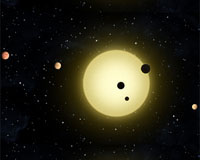 Earth-Size Planet Candidates Found In Habitable Zone
Pasadena, CA (SPX) Feb 3, 2011 NASA's Kepler mission has discovered its first Earth-size planet candidates and its first candidates in the habitable zone, a region where liquid water could exist on a planet's surface. Five of the potential planets are near Earth-size and orbit in the habitable zone of smaller, cooler stars than our sun. Candidates require follow-up observations to verify they are actual planets. Kepler ... read more |
|
|
| The content herein, unless otherwise known to be public domain, are Copyright 1995-2010 - SpaceDaily. AFP and UPI Wire Stories are copyright Agence France-Presse and United Press International. ESA Portal Reports are copyright European Space Agency. All NASA sourced material is public domain. Additional copyrights may apply in whole or part to other bona fide parties. Advertising does not imply endorsement,agreement or approval of any opinions, statements or information provided by SpaceDaily on any Web page published or hosted by SpaceDaily. Privacy Statement |


 del.icio.us
 Digg
Digg Reddit
 YahooMyWeb
 Google
 Facebook


