|
 |
 |
 |
 |
 |
 |
 |
 |
 |

| . |  |
. |
Light Continues To Echo Three Years After Stellar Outburst
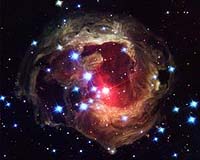
Washington DC (SPX) Feb 07, 2005 The illumination of interstellar dust comes from the red supergiant star at the middle of the image, which gave off a pulse of light three years ago, somewhat similar to setting off a flashbulb in a darkened room. The dust surrounding V838 Mon may have been ejected from the star during a previous explosion, similar to the 2002 event. The echoing of light through space is similar to the echoing of sound through air. As light from the stellar explosion continues to propagate outwards, different parts of the surrounding dust are illuminated, just as a sound echo bounces off of objects near the source, and later, objects further from the source. Eventually, when light from the back side of the nebula begins to arrive, the light echo will give the illusion of contracting, and finally it will disappear. V838 Mon is located about 20,000 light-years away from Earth in the direction of the constellation Monoceros, placing the star at the outer edge of our Milky Way galaxy. The Hubble telescope has imaged V838 Mon and its light echo several times since the star's outburst. Each time Hubble observes the event, different thin sections of the dust are seen as the pulse of illumination continues to expand away from the star at the speed of light, producing a constantly changing appearance. During the outburst event whose light reached Earth in 2002, the normally faint star suddenly brightened, becoming 600,000 times more luminous than our Sun. The new image of V838 Mon, taken with Hubble's Advanced Camera for Surveys, was prepared from images obtained through filters that isolate blue, green, and infrared light. These images have been combined to produce a full-colour picture that approximates the true colours of the light echo and the very red star near the centre. Related Links Hubble at NASA Hubble Site SpaceDaily Search SpaceDaily Subscribe To SpaceDaily Express  Even In Heaven, Stars Can Only Get So Big
 Ann Arbor MI (SPX) Feb 04, 2005
New research from the University of Michigan shows that there may be an upper limit to the mass of a star, somewhere around 120 to 200 times bigger than our sun. |
|
|

| The content herein, unless otherwise known to be public domain, are Copyright 1995-2006 - SpaceDaily.AFP and UPI Wire Stories are copyright Agence France-Presse and United Press International. ESA PortalReports are copyright European Space Agency. All NASA sourced material is public domain. Additionalcopyrights may apply in whole or part to other bona fide parties. Advertising does not imply endorsement,agreement or approval of any opinions, statements or information provided by SpaceDaily on any Web page published or hosted by SpaceDaily. Privacy Statement |