
 |
 |
 |
 |
 |
 |
 |
 |
 |
 |

| . |  |
. |

Munich, Germany (SPX) Apr 25, 2011 For years, ultrasound has proven to be a valuable tool in non-destructive materials testing. However, the demands of modern production conditions are increasing all the time. Researchers at Fraunhofer have now developed a new, more reliable process that delivers testing results at a rate that is up to a hundredfold higher. Expectant mothers are familiar with the procedure: the physician examines them with an ultrasound apparatus that displays lifelike images of the fetus on the monitor. The application of this technology has been customary in medicine for years; in materials testing though, it has been used only in relatively rudimentary form to date. Researchers at the Fraunhofer Institute for Non-Destructive Testing IZFP in Saarbrucken have adapted the conventional sonar procedure - a simple ultrasound method - and have succeeded in generating three-dimensional images with the aid of innovative software. At the same time, they have increased the testing rate a hundredfold. Many areas of quality assurance or production for the construction industry call for reliable testing methods: be it pipelines, railway wheels, components for power plants, bridge piers or items mass-produced by the thousands, there is a need to ensure that deep down the items produced are free from tiny fissures or imperfections. For many years, ultrasound has proven a valuable tool in non-destructive materials testing. An ultrasonic transducer radiates sound waves into the workpiece, and the time the signals require to travel and be reflected back indicates where material defects are located. Scanning workpieces in this way is relatively time-consuming, since, an inspection tact can only register a single beam angle. Thus many measurements must be performed to assemble the composite image suitable for evaluation of inspection results. However, this approach is too slow if ultrasound testing is to be integrated in ongoing production or applied to large components. That is why Dr.-Ing. Andrey Bulavinov and his team at IZFP have developed a new method that works at up to 100 times the speed. "We no longer use the sonar method that emits a sound field in just one particular direction. Instead, we use the probe - which experts refer to as a "phased array" - to generate a defocused, non-directional wave that penetrates the material," the engineer explains. "What we get back are signals coming from all directions, and the computer uses these signals to reconstruct the composite image." In a manner similar to subterranean seismic testing, it analyzes physical changes the wave encounters in the material - diffraction and heterodyning - and uses this information to determine the conditions within the material itself. "We follow the sound field," Bulavinov notes, "and calculate the workpiece characteristics on the basis of that." Similar to computer tomography in medicine, in the end we receive three-dimensional images of the examined object where any imperfections are easy to identify. The startling thing about this approach is that with it, a fissure is now visible even if the ultrasound was not specifically directed at it. I-Deal Technologies, an IZFP spinoff, markets testing systems based on this principle. "The method is suitable for virtually all materials used in the aerospace as well as the automobile industry, particularly for lightweight materials," managing director Bulavinov emphasizes. "Our method is even suited for use with austenitic steel - a type of steel that currently can be tested with traditional ultrasound methods only to a very limited degree." Upon request, the researchers also offer a fully automated quantitative analysis of the ultrasound test results. The IZFP is also demonstrating this method at Control 2011, the International Trade Fair for Quality Assurance, in Stuttgart from May 3-6 (Hall 1, Stand 1502). Research News April 2011 [ PDF 414KB ]
Share This Article With Planet Earth
Related Links Fraunhofer Space Technology News - Applications and Research

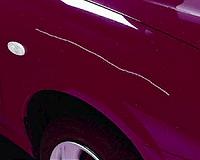 A scratched coating heals itself
Cleveland OH (SPX) Apr 25, 2011 Your 6-year-old found a nail in the garage and drew pictures across the side of your new car. Gnash your teeth now, but researchers at Case Western Reserve University, U.S., say the fix-up may be cheap and easy to do yourself in the not-too-distant future. Together with partners in the USA and Switzerland, they have developed a polymer-based material that can heal itself when placed under ... read more |
|
|
| The content herein, unless otherwise known to be public domain, are Copyright 1995-2010 - SpaceDaily. AFP and UPI Wire Stories are copyright Agence France-Presse and United Press International. ESA Portal Reports are copyright European Space Agency. All NASA sourced material is public domain. Additional copyrights may apply in whole or part to other bona fide parties. Advertising does not imply endorsement,agreement or approval of any opinions, statements or information provided by SpaceDaily on any Web page published or hosted by SpaceDaily. Privacy Statement |


 del.icio.us
 Digg
Digg Reddit
 YahooMyWeb
 Google
 Facebook


