|
 |
 |
 |
 |
 |
 |
 |
 |
 |

| . |  |
. |
Link Discovered Between Earth's Ocean Currents And Jupiter's Bands
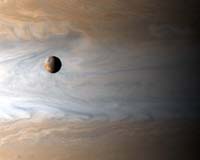
Washington (SPX) Jun 22, 2004 Scientists have discovered a striking similarity between certain ocean currents on Earth and the bands that characterize the surface of large, gaseous planets like Jupiter. Boris Galperin of the University of South Florida's College of Marine Science in Saint Petersburg and colleagues in the United States, Israel, and Japan report their findings later this month in Geophysical Research Letters, published by the American Geophysical Union. "The banded structure of Jupiter has long been a subject of fascination and intensive research," says Galperin, a physical oceanographer who analyzes turbulence theory and applies theory and numerical modeling to analyze planetary processes. "The visible bands on Jupiter are formed by clouds moving along a stable set of alternating flows." Galperin and his colleagues have discovered that oceans on Earth also harbor stable alternating bands of current that, when modeled, are similar to the bands on Jupiter, due to the same kinds of "jets." "We think this resemblance is more than just visual," says Galperin. "The energy spectrum of the oceanic jets obeys a power law that fits the spectra of zonal flows on the outer planets." The observation begs the question of whether these similar phenomena are rooted in similar physical forces. "To answer this question," says Galperin, "one needs to determine what physical processes govern the large-scale dynamics in both systems." According to Galperin, there is a similarity in the forcing agents for planetary and oceanic circulations. The study maintains that both sets of zonal jets -- the ocean's bands of currents and the bands of Jupiter's clouds � are the result of an underlying turbulent flow regime common in nature. Comparing the energy spectra on giant planets and in Earth's oceans can yield valuable information about the transport properties of the oceans, says Galperin, especially about the strongest currents in the mid-depth ocean. "The implications of these findings for climate research on Earth and the designs of future outer space observational studies are important," he says. Related Links South Florida's College of Marine Science SpaceDaily Search SpaceDaily Subscribe To SpaceDaily Express  Researchers Show Io Vaporizing Rock Gases Into Atmosphere
 St. Louis MO (SPX) Jun 16, 2004
The hottest spot in the solar system is neither Mercury, Venus, nor St. Louis in the summer. Io, one of the four satellites that the Italian astronomer Galileo discovered orbiting Jupiter almost 400 years ago, takes that prize. |
|
|

| The content herein, unless otherwise known to be public domain, are Copyright 1995-2006 - SpaceDaily.AFP and UPI Wire Stories are copyright Agence France-Presse and United Press International. ESA PortalReports are copyright European Space Agency. All NASA sourced material is public domain. Additionalcopyrights may apply in whole or part to other bona fide parties. Advertising does not imply endorsement,agreement or approval of any opinions, statements or information provided by SpaceDaily on any Web page published or hosted by SpaceDaily. Privacy Statement |