|
 |
 |
 |
 |
 |
 |
 |
 |
 |

| . |  |
. |
LockMart Thermoelectric Generator Powers NASA Pluto New Horizons Probe
Valley Forge PA (SPX) Jan 20, 2006 A Radioisotope Thermoelectric Generator (RTG), built by Lockheed Martin at its Space Systems Company facility in Valley Forge, then fueled by the U.S. Department of Energy (DOE), is providing electric power for NASA's Pluto New Horizons spacecraft. Launched this afternoon from the Kennedy Space Center aboard a Lockheed Martin Atlas V launch vehicle, the pioneering mission will undertake the first close-up reconnaissance of the solar system's most distant planet and its moon Charon in 2015, following a nine-year traverse of the solar system. "It is because of a long and productive partnership with the DOE that we can work together to provide the energy technology that enables this close-up study of Pluto and the Kuiper Belt," said Robert W. Hepler, Lockheed Martin Radioisotope Powered Systems program manager. "It is with particular pride that we, as a company, are once again able to contribute to a seminal voyage of exploration." Pluto, the only solar system planet yet to be explored by NASA, has a highly eccentric orbit averaging nearly six billion kilometers away from the Sun. At so great a distance, sunlight at Pluto provides only about 1/1600th of the solar energy available at Earth. Consequently, it is not possible to power the Pluto New Horizons spacecraft with solar cells. A General Purpose Heat Source Radioisotope Thermoelectric Generator (GPHS-RTG) provides electrical power for the Pluto mission. Electricity for the Pluto New Horizons spacecraft is generated from the conversion of heat caused by the radioactive decay of plutonium in the form of plutonia (PuO2). The RTG contains 18 heat source modules, with four 151-gram plutonia pellets in each. With a total mass of plutonia at 10.9 kilograms, the RTG will provide approximately 250 watts of power at the beginning of the mission. After the Pluto encounter, the New Horizons spacecraft will head to the Kuiper Belt, a disk-shaped cloud beyond the orbit of Neptune where short- period comets are thought to form and objects called ice dwarfs and minor planets have been detected. New Horizons hopes to visit multiple Kuiper Belt Objects (KBOs). The KBO encounters and mission tasks are similar to the Pluto-Charon encounter. The spacecraft will map the surface of each KBO, measure composition using infrared spectroscopy and generate four-color maps. It will also search for any atmosphere. This phase of the mission could last from five to 10 years. The primary scientific objectives of the Pluto New Horizons mission during the Pluto-Charon and KBO encounters include: characterization of the global geology and morphology, mapping of the surface composition and, characterization of the neutral atmosphere and its escape rate. Today's launch provides an opportunity for the spacecraft to perform a gravity assist maneuver with Jupiter, enabling it to reach Pluto by 2015. Related Links  NASA Delays Pluto Probe Launch Again
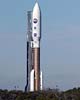 Washington DC (SPX) Jan 19, 2006
NASA has postponed the launch of its New Horizons Pluto probe "for at least one more day" due to a power outage at the laboratory managing the mission, the US space agency said Wednesday. |
|
|

| The content herein, unless otherwise known to be public domain, are Copyright 1995-2006 - SpaceDaily.AFP and UPI Wire Stories are copyright Agence France-Presse and United Press International. ESA PortalReports are copyright European Space Agency. All NASA sourced material is public domain. Additionalcopyrights may apply in whole or part to other bona fide parties. Advertising does not imply endorsement,agreement or approval of any opinions, statements or information provided by SpaceDaily on any Web page published or hosted by SpaceDaily. Privacy Statement |