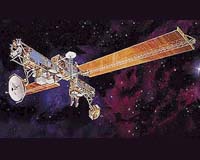
File image of Mistar class satellite.
File image of Mistar class satellite. |
The Milstar system is the only survivable, endurable means that the President, the Secretary of Defense and the Commander, U.S. Strategic Command have to maintain positive command and control of this nation's strategic forces.
This reconfiguration, which entailed repositioning the satellites relative to one another to maximize and improve the constellation's earth coverage visibility, was successfully executed during a seven-month period by a team of engineers from Lockheed Martin Space Systems, Sunnyvale, Calif., the Milstar prime contractor, working with the 4th Space Operations Squadron at Schriever AFB, Colo., the Air Force's team which flies and maintains the Milstar constellation.
This proven ability to realign the operational location of the entire spacecraft constellation with no unplanned service disruptions to military forces deployed around the globe will be vital to bringing the follow-on Advanced Extremely High Frequency (AEHF) satellites into the nation's survivable, secure MILSATCOM architecture.
"We are proud of the capability we have demonstrated to increase the effectiveness of this critical system to our customer, said Leonard F. Kwiatkowski, Lockheed Martin's vice president and general manager of Military Space Programs. "Designed, built and operated by a talented and dedicated group of people, Milstar continues to deliver critical secure, real-time, connectivity to the warfighter and we look forward to achieving mission success as we prepare to launch the first AEHF satellite next year."
The AEHF team is led by the MILSATCOM Systems Wing, located at the Space and Missile Systems Center, Los Angeles Air Force Base, Calif.
Community
 Russia Puts Cosmos Military Satellite In Orbit
 Moscow (RIA) Jul 01, 2007
| The content herein, unless otherwise known to be public domain, are Copyright 1995-2006 - SpaceDaily.AFP and UPI Wire Stories are copyright Agence France-Presse and United Press International. ESA PortalReports are copyright European Space Agency. All NASA sourced material is public domain. Additionalcopyrights may apply in whole or part to other bona fide parties. Advertising does not imply endorsement,agreement or approval of any opinions, statements or information provided by SpaceDaily on any Web page published or hosted by SpaceDaily. Privacy Statement |