|
 |
 |
 |
 |
 |
 |
 |
 |
 |

| . |  |
. |
Lockheed Martin Team Delivers Critical Payload For SBIRS High Program
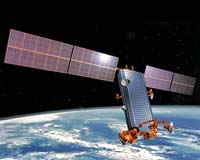
Sunnyvale (SPX) Aug 12, 2004 Lockheed Martin today announced the delivery of the first space payload for the Space-Based Infrared System High (SBIRS High) program. The payload was delivered for integration with a host satellite and eventual launch into a highly elliptical orbit (HEO) around the earth. The HEO payload's primary mission is to scan for ballistic missile launches; adjunct missions include detecting and reporting other infrared events of military interest. In addition to serving as the nation's next-generation missile warning system, SBIRS provides greatly expanded capabilities for intelligence, surveillance and reconnaissance (ISR) missions. SBIRS High will enable combat commanders the flexibility to gain valuable insight into an adversary's battle space and provide both tactical and strategic missile warning around the globe. "SBIRS represents a program of unprecedented capabilities and complexity and we cannot overstate the importance of this payload delivery. When deployed, the SBIRS HEO payload will be invaluable to our warfighters, contributing to our nation's missile defense infrastructure and affording multi-mission features that are unparalleled," said G. Thomas Marsh, executive vice president, Lockheed Martin Space Systems Company. Developed jointly by Lockheed Martin and its subcontractor Northrop Grumman, the HEO payload underwent extensive testing at Northrop Grumman's Azusa, Calif., facility prior to delivery and demonstrated unsurpassed sensing, pointing and control performance. "Northrop Grumman is committed to delivering the highest quality SBIRS payloads. This HEO delivery is the first in a series of payloads that will provide revolutionary support to missile warning/defense and the warfighters," said Bob Iorizzo, president, Electronic Systems sector, Northrop Grumman Corporation. SBIRS High already is providing the nation enhanced worldwide missile detection and tracking capabilities, battlefield data, and technical intelligence through its ground segment. The first phase of the program, declared operational in 2001, consolidated ground functions of four remote sites into one centralized ground station. In addition to processing missile-warning data from Defense Support Program (DSP) satellites currently on orbit and managing the DSP constellation, the SBIRS ground station is credited with delivering significant operations and maintenance savings for its customer. The U.S. Air Force manages the SBIRS High program from its Space and Missile Systems Center at Los Angeles Air Force Base, with Air Force Space Command responsible for the operation of the SBIRS system. When fully operational, SBIRS High will comprise two payloads in highly elliptical orbit, four satellites in geosynchronous orbit, as well as fixed and mobile ground- based assets to receive and process the infrared data. Lockheed Martin also recently delivered the first geosynchronous orbit (GEO) Pointing and Control Assembly (PCA) to Northrop Grumman. The PCA allows the optical telescopes to be positioned to scan and stare at designated areas, enabling operators to modify the areas of surveillance according to national priorities. The GEO PCA features Lockheed Martin's patented reaction-less gimbal system, which allows the satellite to rapidly and repeatedly scan an area of interest for infrared activity while not interfering with the satellite's ability to simultaneously stare at another area. Northrop Grumman is in the early stages of integrating the first flight GEO payload and has begun installing the scanning and staring telescopes within the PCA. Additionally, the SBIRS High ground component is on track to fully support the U.S. Missile Defense Agency's (MDA) Initial Defensive Operations. Working with MDA, Lockheed Martin developed algorithms to provide new capabilities, which will enable the tracking of ballistic missiles further in their flight. This capability has been successfully tested within the SBIRS ground component and is ready to be tested with MDA system elements. Related Links Lockheed Martin Corporation SpaceDaily Search SpaceDaily Subscribe To SpaceDaily Express  Search And Rescue Group Uses Sandia Synthetic Aperture Radar
 Albuquerque NM (SPX) Aug 11, 2004
A radar, originally developed by the National Nuclear Security Administration's Sandia National Laboratories for military surveillance and reconnaissance applications, is helping a volunteer search and rescue group save lives. |
|
|

| The content herein, unless otherwise known to be public domain, are Copyright 1995-2006 - SpaceDaily.AFP and UPI Wire Stories are copyright Agence France-Presse and United Press International. ESA PortalReports are copyright European Space Agency. All NASA sourced material is public domain. Additionalcopyrights may apply in whole or part to other bona fide parties. Advertising does not imply endorsement,agreement or approval of any opinions, statements or information provided by SpaceDaily on any Web page published or hosted by SpaceDaily. Privacy Statement |