
 |
 |
 |
 |
 |
 |
 |
 |
 |
 |

| . |  |
. |

Laurel MD (SPX) Mar 10, 2011 After more than a dozen laps through the inner solar system, NASA's MESSENGER spacecraft will move into orbit around Mercury on March 17, 2011. The durable spacecraft--carrying seven science instruments and fortified against the blistering environs near the sun - will be the first to orbit the innermost planet. At 8:45 p.m. EDT, MESSENGER - having pointed its largest thruster very close to the direction of travel - will fire that thruster for nearly 14 minutes, with other thrusters firing for an additional minute, slowing the spacecraft by 862 meters per second (1,929 mph) and consuming 31 percent of the propellant that the spacecraft carried at launch. Less than 9.5 percent of the usable propellant at the start of the mission will remain after completing the orbit insertion maneuver, but the spacecraft will still have plenty of propellant for future orbit correction maneuvers. The orbit insertion will place the spacecraft into a 12-hour orbit about Mercury with a 200 kilometer (124 mile) minimum altitude. At the time of orbit insertion, MESSENGER will be 46.14 million kilometers (28.67 million miles) from the sun and 155.06 million kilometers (96.35 million miles) from Earth. MESSENGER has been on a six-year mission to become the first spacecraft to orbit Mercury. The spacecraft followed a path through the inner solar system, including one flyby of Earth, two flybys of Venus, and three flybys of Mercury. This impressive journey is returning the first new spacecraft data from Mercury since the Mariner 10 mission over 30 years ago. On March 7, antennas from each of the three Deep Space Network (DSN) ground stations began continuous monitoring, allowing flight control engineers at the Johns Hopkins University Applied Physics Laboratory to observe MESSENGER on its final approach to Mercury. The spacecraft also began executing the last cruise command sequence of the mission, when the command sequence containing the orbit-insertion burn will start. "This is a milestone event for our small, but highly experienced, operations team, marking the end of six and one half years of successfully shepherding the spacecraft through six planetary flybys, five major propulsive maneuvers, and sixteen trajectory-correction maneuvers, all while simultaneously preparing for orbit injection and primary mission operations," said MESSENGER Systems Engineer Eric Finnegan. "Whatever the future holds, this team of highly dedicated engineers has done a phenomenal job methodically generating, testing, and verifying commands to the spacecraft, getting MESSENGER where it is today." "The cruise phase of the MESSENGER mission has reached the end game," adds MESSENGER Principal investigator Sean Solomon, of the Carnegie Institution of Washington. "Orbit insertion is the last hurdle to a new game level, operation of the first spacecraft in orbit about the solar system's innermost planet. The MESSENGER team is ready and eager for orbital operations to begin."
Share This Article With Planet Earth
Related Links MESSENGER News Flash at Mercury Mars News and Information at MarsDaily.com Lunar Dreams and more

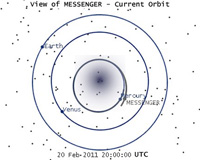 One Month Until Mercury Orbit Insertion
Laurel MD (APL) Feb 21, 2011 After more than a dozen laps through the inner solar system, NASA's Messenger spacecraft will move into orbit around Mercury on March 17, 2011. The durable spacecraft - carrying seven science instruments and fortified against the blistering environs near the Sun - will be the first to orbit the innermost planet. At 8:45 p.m. EDT, Messenger - having pointed its largest thruster very close t ... read more |
|
|
| The content herein, unless otherwise known to be public domain, are Copyright 1995-2010 - SpaceDaily. AFP and UPI Wire Stories are copyright Agence France-Presse and United Press International. ESA Portal Reports are copyright European Space Agency. All NASA sourced material is public domain. Additional copyrights may apply in whole or part to other bona fide parties. Advertising does not imply endorsement,agreement or approval of any opinions, statements or information provided by SpaceDaily on any Web page published or hosted by SpaceDaily. Privacy Statement |


 del.icio.us
 Digg
Digg Reddit
 YahooMyWeb
 Google
 Facebook


