|
 |
 |
 |
 |
 |
 |
 |
 |
 |

| . |  |
. |
MIT Closes In On Bionic Speed
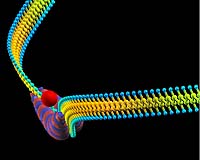
Cambridge MA (SPX) Nov 08, 2005 Robots, both large and micro, can potentially go wherever it's too hot, cold, dangerous, small or remote for people to perform any number of important tasks, from repairing leaking water mains to stitching blood vessels together. Now MIT researchers, led by Professor Sidney Yip, have proposed a new theory that might eliminate one obstacle to those goals - the limited speed and control of the "artificial muscles" that perform such tasks. Currently, robotic muscles move 100 times slower than ours. But engineers using the Yip lab's new theory could boost those speeds - making robotic muscles 1,000 times faster than human muscles - with virtually no extra energy demands and the added bonus of a simpler design. This study appears in the Nov. 4 issue of the journal Physical Review Letters. In this case, a robotic muscle refers to a device that can be activated to perform a task, like a sprinkler activated by pulling a fire alarm lever, explains Yip, a professor of nuclear engineering and materials science and engineering. In the past few years, engineers have made the artificial muscles that actuate, or drive, robotic devices from conjugated polymers. "Conjugated polymers are also called conducting polymers because they can carry an electric current, just like a metal wire," says Xi Lin, a postdoctoral associate in Yip's lab. (Conventional polymers like rubber and plastic are insulators and do not conduct electricity.) Conjugated polymers can actuate on command if charges can be sent to specific locations in the polymer chain in the form of "solitons" (charge density waves). A soliton, short for solitary wave, is "like an ocean wave that can travel long distances without breaking up," Yip adds. Scientists already knew that solitons enabled the conducting polymers to conduct electricity. Lin's work attempts to explain how these materials can activate devices. This study is useful because until now, scientists, hampered by not knowing the mechanism, have been making conducting polymers in a roundabout way, by bathing (doping) the materials with ions that expand the volume of the polymer. That expansion was thought to give the polymers their strength, but it also makes them heavy and slow. Lin discovered that adding the ions is unnecessary, because theoretically, shining a light of a particular frequency on the conducting polymer can activate the soliton. Without the extra weight of the added ions, the polymers could bend and flex much more quickly. And that rapid-fire motion gives rise to the high-speed actuation, that is, the ability to activate a device. To arrive at these conclusions, Lin worked from fundamental principles to understand the physical mechanisms governing conjugated polymers, rather than using experimental data to develop hypotheses about how they worked. He started with Schr�dinger's equation, a hallmark of quantum mechanics that describes how a single electron behaves (its wave function). But solving the problem of how a long chain of electrons behaves was another matter, requiring long and complex analyses. Related Links SpaceDaily Search SpaceDaily Subscribe To SpaceDaily Express  New Sensor Based On Human Organ Is No Tin Ear
 Washington DC (SPX) Nov 08, 2005
Researchers at the University of Michigan are developing a mechanical cochlea, a device that functions much like its human counterpart in the ear. |
|
|

| The content herein, unless otherwise known to be public domain, are Copyright 1995-2006 - SpaceDaily.AFP and UPI Wire Stories are copyright Agence France-Presse and United Press International. ESA PortalReports are copyright European Space Agency. All NASA sourced material is public domain. Additionalcopyrights may apply in whole or part to other bona fide parties. Advertising does not imply endorsement,agreement or approval of any opinions, statements or information provided by SpaceDaily on any Web page published or hosted by SpaceDaily. Privacy Statement |