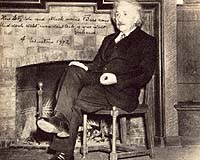
Einstein believed that in order to measure any property of gravity, one has to use test particles.
Einstein believed that in order to measure any property of gravity, one has to use test particles. |
Sergei Kopeikin, associate professor of physics and astronomy in the College of Arts and Science, believes that his latest article, "Gravimagnetism, causality, and aberration of gravity in the gravitational light-ray deflection experiments" published along with Edward Fomalont from the National Radio Astronomical Observatory, arrives at a consensus in the continuing debate that has divided the scientific community.
An experiment conducted by Fomalont and Kopeikin five years ago found that the gravity force of Jupiter and light travel at the same speed, which validates Einstein's suggestion that gravity and electromagnetic field properties, are governed by the same principle of special relativity with a single fundamental speed.
In observing the gravitational deflection of light caused by motion of Jupiter in space, Kopeikin concluded that mass currents cause non-stationary gravimagnetic fields to form in accordance with Einstein's point of view. The research paper that discusses the gravimagnetic field appears in the October edition of Journal of General Relativity and Gravitation.
Einstein believed that in order to measure any property of gravity, one has to use test particles. "By observing the motion of the particles under influence of the gravity force, one can then extract properties of the gravitational field," Kopeikin said. "Particles without mass - such as photons - are particularly useful because they always propagate with constant speed of light irrespectively of the reference frame used for observations."
The property of gravity tested in the experiment with Jupiter also is called causality. Causality denotes the relationship between one event (cause) and another event (effect), which is the consequence (result) of the first. In the case of the speed of gravity experiment, the cause is the event of the gravitational perturbation of photon by Jupiter, and the effect is the event of detection of this gravitational perturbation by an observer.
The two events are separated by a certain interval of time which can be measured as Jupiter moves, and compared with an independently-measured interval of time taken by photon to propagate from Jupiter to the observer. The experiment found that two intervals of time for gravity and light coincide up to 20 percent. Therefore, the gravitational field cannot act faster than light propagates."
Other physicists argue that the Fomalont-Kopeikin experiment measured nothing else but the speed of light. "This point of view stems from the belief that the time-dependent perturbation of the gravitational field of a uniformly moving Jupiter is too small to detect," Kopeikin said. "However, our research article clearly demonstrates that this belief is based on insufficient mathematical exploration of the rich nature of the Einstein field equations and a misunderstanding of the physical laws of interaction of light and gravity in curved space-time."
Community
 Stopping Atoms
 Austin TX (SPX) Oct 04, 2007
| The content herein, unless otherwise known to be public domain, are Copyright 1995-2006 - SpaceDaily.AFP and UPI Wire Stories are copyright Agence France-Presse and United Press International. ESA PortalReports are copyright European Space Agency. All NASA sourced material is public domain. Additionalcopyrights may apply in whole or part to other bona fide parties. Advertising does not imply endorsement,agreement or approval of any opinions, statements or information provided by SpaceDaily on any Web page published or hosted by SpaceDaily. Privacy Statement |