
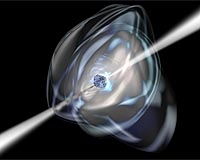
The quick turn-around time of the INTEGRAL operation teams has enabled rare high-energy observations of a magnetar. The observations, which were performed as a Target of Opportunity, followed indications late last week that this magnetar, the Anomalous X-ray Pulsar, 1E 1547.0-5408, had entered outburst mode.
1E1547.0-5408 is one of only 9 confirmed Anomalous X-ray Pulsars (AXP) – isolated, young neutron stars with unusually strong magnetic fields (1014G -1015G). Together with Soft Gamma Repeaters they make up a class of celestial object known as magnetars.
1E 1547.0-5408 was first detected by the Einstein X-ray observatory. Subsequent observations by a series of X-ray observatories (ASCA, Chandra, XMM-Newton and Swift) have shown it to display the typical characteristics of an AXP. It has exhibited a small number of outbursts over the past few years but at weaker levels than those observed in the past few days.
Magnetar active state triggers alerts on several satellites, including INTEGRAL
The first sign that this magnetar had entered a new active burst state came early on Thursday 22 January when the Swift Burst Alert Telescope (GCN 8833) and the Fermi Gamma-Ray Burst Monitor (GCN 8835) recorded a number of hard X-ray triggers which were identified as originating from the direction of 1E 1547.0-5408.
Volker Beckmann and the team at the INTEGRAL Science Data Centre (ISDC), monitoring the real-time data from the almost omni-directional SPI anti-coincidence system (ACS), which operates as a burst trigger on INTEGRAL, also noticed a significant increase in triggers: almost 200 on 22 January compared to a typical rate of a few per day.
The bursts were among the brightest ever recorded by the ACS in the 6 years since INTEGRAL was launched and varied in length from 50ms to 8 seconds. The ACS has a lower energy threshold of 50-150 keV (depending on the individual detector) and an upper threshold of about 100 MeV.
Although the ACS cannot localise the position of a burst source the temporal coincidence of some of the bursts with those identified by Swift and Fermi confirmed the source of the burst emission to be 1E 1547.0-5408 (GCN 8837).
Exceptional activity results in public Target of Opportunity
Recognising that this was a rare opportunity to observe close to, and possibly during, an outburst state, Beckmann and other scientists submitted Target of Opportunity requests for immediate observations of this object to the INTEGRAL Science Operations Team.
These were received on 22 and 23 January. After careful consideration the ToO was granted by the INTEGRAL Project Scientist, Christoph Winkler, and a 100,000 second observation planned and executed. This ToO began at 15:30:59 on 24 January and continued until the end of the visibility window at 22:14:36 on 25 January.
Given the interest expressed by the scientific community in these observations the Project Scientist declared the ToO to be public and all scientific data recorded during this ToO has now been made publicly available from the INTEGRAL Science Data Centre at Geneva. (See the link to ToO data for 1E 1547.0-5408 on the right-hand menu.)
Early results: magnetar still active, spectrum measured
A preliminary examination of the data indicates that the magnetar was still in an active phase during the ToO and that it was detected by all X-ray instruments on-board the satellite.
Apart from bursts, which occurred during the observation and were again seen by several satellites, it was also possible to determine the X-ray spectrum of this AXP. The spectrum extends up to energies of at least 150 keV and has the signature of processes usually associated with emission of a jet or other non-thermal processes, rather than showing a "hot spot" on the neutron star's surface (ATEL 1908).
A simultaneous observation of lower energy X-rays by the Swift satellite indicates that the X-ray emission is travelling towards us through dusty regions of our Galaxy causing ring-like halos in the X-ray images (GCN 8848). This allows scientists now not only to study the neutron star itself, but also the interstellar medium of the Milky Way.
Further observations of 1E 1547.0-5408 with INTEGRAL are planned for later this week as part of an additional dedicated observation.
Share This Article With Planet Earth
