|
 |
 |
 |
 |
 |
 |
 |
 |
 |

| . |  |
. |
Major Milestone Reached For High-Data-Rate Laser Communications
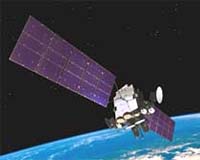
Redondo Beach CA (SPX) Apr 03, 2006 With the successful completion of a preliminary compatibility test, the Lockheed Martin and Northrop Grumman Transformational Satellite Communications System (TSAT) space segment team has built and tested high-data-rate laser communications hardware that meets a newly defined U.S. government lasercom interoperability standard. Lasercom is a key technology to be used in the U.S. Air Force's TSAT program that will deliver vastly improved communications abilities to a wide variety of users. The first test, OSVS-1, of the lasercom terminal hardware, built by the Northrop Grumman Space Technology sector, was conducted from early November to mid-December 2005 against the Optical Systems Validation Suite (OSVS) testbed at Massachusetts Institute of Technology's Lincoln Laboratory. The second phase of testing, OSVS-2, is scheduled to be completed by February 2007. The test measured the quality of communication between the Northrop Grumman lasercom terminal and the government terminal (OSVS) testbed, including the ability to point, acquire and track another lasercom terminal and to maintain that tracking in the presence of spacecraft jitter (shaking). Test results proved the hardware can perform at data rates of 10 and 40 gigabits per second and is at a level of maturity consistent with objectives for OSVS-1. Instead of radio frequencies, laser terminals communicate by sending modulated beams of light and are smaller and more cost effective for high-data-rate systems needed for the increasing bandwidth demands of U.S. warfighters. "Successfully completing this test on schedule represents an important milestone in retiring risk for lasercom technology that will be deployed in operational systems," noted Stuart Linsky, Northrop Grumman vice president, Satellite Communications. The test demonstrated a single-access optical aperture, which is the front end of a communications terminal that uses a laser to transmit and receive information. The beam width of a lasercom terminal is extremely small, requiring precision pointing, scanning and tracking performance to lock on to and communicate with another terminal. The terminal is designed to maintain tracking when mounted on a spacecraft. The optical aperture uses mechanized mirrors to point toward and track the other terminal. Northrop Grumman's partner, SSG Precision Optronics, Wilmington, Mass., manufactured the telescope used in the test. The U.S. Air Force identified laser communications as a key risk technology needed for TSAT, which will provide high-bandwidth, Internet protocol-based satellite communications to the future warfighter. "Working closely with our customer, our team has successfully demonstrated our technological readiness essential for achieving mission success on TSAT," said Rick Skinner, vice president, Transformational Communications for Lockheed Martin. "We look forward to working with the Air Force to provide a cutting-edge system that will meet the vital communications needs and requirements of the warfighter." The Lockheed Martin / Northrop Grumman TSAT space segment team, which includes ViaSat, Rockwell Collins, General Dynamics Advanced Information Systems, L-3 Communications, Stratogis and Caspian Networks, is currently working under a $514 million contract for the Risk Reduction and System Definition phase. This effort will culminate with a multi-billion dollar development contract to be awarded to a single contractor in 2008. Related Links Northrop Grumman Mission Systems  UK Army To Get High Tech New Battlefield Communications Network
 London, UK (SPX) Apr 03, 2006
The Army is to get a new air-portable battlefield communications network called FALCON under a contract worth in excess of 200m pounds, Minister for Defence Procurement, Lord Drayson, has nnounced. |
|
|

| The content herein, unless otherwise known to be public domain, are Copyright 1995-2006 - SpaceDaily.AFP and UPI Wire Stories are copyright Agence France-Presse and United Press International. ESA PortalReports are copyright European Space Agency. All NASA sourced material is public domain. Additionalcopyrights may apply in whole or part to other bona fide parties. Advertising does not imply endorsement,agreement or approval of any opinions, statements or information provided by SpaceDaily on any Web page published or hosted by SpaceDaily. Privacy Statement |