
 |
 |
 |
 |
 |
 |
 |
 |
 |
 |

| . |  |
. |
Marooned In Five-Dimensional Space
London - December 24, 1999 - Space may have a fifth dimension--one more than the four we are familiar with, say two physicists. And it could be infinite, unlike the tiny extra space dimensions that have been proposed in the past. "Incredibly, it could have gone completely unnoticed until now," says Raman Sundrum of Stanford University in California. Physicists take extra dimensions seriously because superstring theory, the best candidate for a "theory of everything", requires at least nine space dimensions. "There are two ways the extra dimensions could conceal themselves from view," says Sundrum. "One is if they are rolled up far smaller than an atom. The other is if the universe is confined to a kind of lower-dimensional island within higher-dimensional space." An infinitely thin two-dimensional piece of paper would form such an island within normal 3D space. This latter possibility has now been explored by Sundrum and his colleague Lisa Randall of Princeton University, New Jersey. Remarkably, superstring theory requires lower-dimensional islands, or "branes". And in superstring theory, nature's three non-gravitational forces--the electromagnetic, weak and strong forces--can be naturally constrained to operate only within a brane. Gravity is a problem, however. "Gravity is intimately connected with the dynamics of space-time and so necessarily extends into all extra dimensions," says Sundrum. Gravity from bodies such as the Sun should theoretically spread into this large extra space dimension, effectively diluting it within our universe's brane. "It would weaken with distance far faster than the inverse-square law decline that we observe," says Sundrum. But Sundrum and Randall have discovered this may not be so. "The key is the gravity of the brane itself, which is enormous," says Sundrum. Gravity pulls on all sources of energy, including the energy contained in a gravitational field. "Consequently, the gravity of the brane pulls on the gravity of objects like the Sun, preventing it from extending very far beyond the brane," says Sundrum. Crucially, with gravity confined to the brane, the force is undiluted and displays the familiar inverse-square law. And the mechanism for confining gravity works no matter how big the extra space dimension.
"What's so amazing is that the theory mimics familiar four-dimensional gravity so well that it would be very difficult to tell that there is an extra dimension," says Randall.  Aerospike Engine Gets Full Power Test
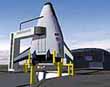 Washington - December 24, 1999 -
 A new type of rocket engine that will propel the X-33 experimental launch vehicle was tested to full power for the first time Dec. 18. The 18-second test of the XRS-2200 Linear Aerospike Engine was conducted on the A-1 test facility at NASA's John C. Stennis Space Center in south Mississippi. |
|
|

|
|
|
|
|
|
|
|
|
|
|
|
| The content herein, unless otherwise known to be public domain, are Copyright 1995-2006 - SpaceDaily.AFP and UPI Wire Stories are copyright Agence France-Presse and United Press International. ESA PortalReports are copyright European Space Agency. All NASA sourced material is public domain. Additionalcopyrights may apply in whole or part to other bona fide parties. Advertising does not imply endorsement,agreement or approval of any opinions, statements or information provided by SpaceDaily on any Web page published or hosted by SpaceDaily. Privacy Statement |
