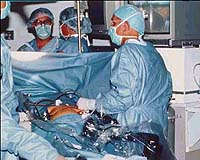
Ticket to space: A medical degree.
Ticket to space: A medical degree. |
He was speaking at an American Physiological Society Education program, "Physiology for Life Science Teachers and Students" session at Experimental Biology 2006 Monday.
Pawelczyk, associate professor of kinesiology and physiology at Pennsylvania State University, said the major challenge of the 21st Century's most ambitious project of reaching Mars "isn't the engineering work to design the spacecraft, because most of those tasks are identified and being addressed. But the greatest unknown questions surround the human body, which will present unprecedented challenges in space life medicine and physiology."
And who's going to solve these problems? "Given the current time frame for a Mars trip in 2020 to 2025, the scientists who will do the research to address these issues are the high school students of today," told the audience which also included many APS physiologists, who look forward to the annual presentation for students and teachers.
Day-long high school program introduces 'inquiry-based' physiological research
Marsha Lakes Matyas, APS Director of Education Programs, said: "APS is pleased to, once again, bring cutting edge physiology to students and teachers in the Bay Area. As a national scientific organization, the APS offers a one-day program that immerses students and teachers in the field of physiology, including the chance to discuss research posters with APS scientists and catch the excitement of scientific discovery through hands on activities."
In addition to Pawelczyk's insights into the challenges of space travel and how earthbound physiological research helps solve some of those issues (and vice-versa), the teachers and students have fun in separate afternoon laboratory sessions. Students will "help Elvis get healthy" by hands-on exploration of the relationship between the circulatory system, exercise and other physiological factors.
At the same time, San Francisco Bay Area teachers will meet with APS Fellowship Teachers from around the country who will demonstrate "inquiry-rich" respiratory lessons and ideas on how to develop similarly exciting laboratory experiences.
Pawelczyk warns of radiation effects, skeletons like 100-year-olds, cancer risk
Speaking as a veteran space traveler, Pawelczyk noted that as currently envisioned, the Mars probe would take as little 13 months to a maximum of 30 months. "We run the possibility of losing nearly half the bone mineral in some regions of the body, which would make the astronauts' skeletons the equivalent of a 100-year-old person," he said. Such fragile bones could fractures, which would be a most unwelcome challenge.
"Another that's less well-known," he said, "is that in deep space there are more highly energetic particles that are ions of metals heavier than iron. On Earth, the only place we see such particles are in fallout from nuclear explosions. But it's estimated that by the time travelers return from Mars, every one of the cells in their body will be transited by a high energy event.
"What happens to the cells' DNA?" Pawelczyk wondered. "How will that affect human biology and cancer risk? Our ability to predict these levels and the error in our estimates probably will be an order of magnitude � plus OR minus," he warned. More positively, he said the U.S. recently activated a facility that will begin to study irradiating biological tissue.
Many ways to join the adventure � and help solve earthly disease mysteries
Pawelczyk assured the students that, "There will be a lot for you to do. For instance, just like experiments on earth will help solve some of the space challenges, studies both here and in space will certainly have the potential to help solve such problems as osteoporosis, muscle wasting and cardiovascular deconditioning that occur among the growing ranks of our elderly and sedentary population."
In concluding, he noted that the "wonder of physiology is that all of the changes we experience in space are the body's automatic adaptations to the new physical environment. They are physiologically appropriate, even though they would certainly be called maladaptations down here on Earth. If we stayed out there that might be all right, but most us want to come home to Mother Earth."
Related Links
 NASA Studies Spaceflight From Under The Sea
 Houston TX (SPX) Mar 29, 2006
| The content herein, unless otherwise known to be public domain, are Copyright 1995-2006 - SpaceDaily.AFP and UPI Wire Stories are copyright Agence France-Presse and United Press International. ESA PortalReports are copyright European Space Agency. All NASA sourced material is public domain. Additionalcopyrights may apply in whole or part to other bona fide parties. Advertising does not imply endorsement,agreement or approval of any opinions, statements or information provided by SpaceDaily on any Web page published or hosted by SpaceDaily. Privacy Statement |