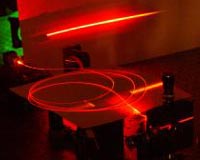
A microstructured optical fiber in NIST's new paired-photon source delivers high numbers of photon pairs over a broad bandwidth with low noise, all in a compact device for quantum communication devices.
A microstructured optical fiber in NIST's new paired-photon source delivers high numbers of photon pairs over a broad bandwidth with low noise, all in a compact device for quantum communication devices. |
In a significant improvement on previous designs, physicists at the National Institute of Standards and Technology (NIST) have devised a system that delivers such pairs with great efficiency over a wide range of energy, and with very little noise from extraneous photons*.
Paired photons can be generated-albeit very inefficiently-in standard optical media such as glass optical fibers. Photons normally travel through glass independently, without interacting, but if monochromatic laser light is sent down even an ordinary optical fiber, very occasionally two of the input photons will interact, producing an output photon pair with one higher in energy than the original photons and the other lower by the same amount.
Because the vast majority of photons go through the fiber unchanged, the relative intensity of these pairs is very small. Worse, the fiber generates the pairs randomly with a range of possible energies, so picking out those with some specific energy reduces the number of useful photon pairs still further.
Worse yet, there is noise in the system due to the phenomenon called "Raman scattering," in which individual photons bounce off the fiber's molecular structure and change their energies. Scattering produces photons that look as if they might be one half of a pair, but aren't.
To beat these odds, the new NIST two-photon source relies on a microstructured optical fiber. The fiber has a slender glass core at the center of an array of hollow channels, giving it a honeycomb appearance in cross-section.
The geometrical structure of the fiber tightly restricts the way light can travel down it, increasing the intensity of light in the thin central core. Higher intensity means that photons are crowded more densely together, making events such as pair production more likely.
That greater efficiency allows the NIST researchers to get significant production of photon pairs by sending laser light through a mere 1.8 meters of the microstructured fiber, in contrast to the hundreds of meters of ordinary fiber that might be used in other systems.
In addition, modifying the size of the channels in the microstructured fiber allows its properties to be optimized to reduce the amount of Raman scattering relative to the two-photon light of interest. The result is a source that produces significantly more pairs of photons over a wide frequency range, and with greatly reduced contamination by spurious Raman photons.
Photon pairs from the new source could be useful, for example, in exploring quantum "entanglement," in which measurements on one of a pair of quantum particles with a common origin exert a subtle influence on the properties of the other, or in quantum cryptography.
Email This Article
Related Links
National Institute of Standards and Technology (NIST)
Powering The World in the 21st Century at Energy-Daily.com
Our Polluted World and Cleaning It Up
China News From SinoDaily.com
Global Trade News
The Economy
All About Solar Energy at SolarDaily.com
Civil Nuclear Energy Science, Technology and News

 Los Angeles CA (SPX) Apr 17, 2007
| The content herein, unless otherwise known to be public domain, are Copyright 1995-2006 - SpaceDaily.AFP and UPI Wire Stories are copyright Agence France-Presse and United Press International. ESA PortalReports are copyright European Space Agency. All NASA sourced material is public domain. Additionalcopyrights may apply in whole or part to other bona fide parties. Advertising does not imply endorsement,agreement or approval of any opinions, statements or information provided by SpaceDaily on any Web page published or hosted by SpaceDaily. Privacy Statement |