|
 |
 |
 |
 |
 |
 |
 |
 |
 |

| . |  |
. |
Massive Transiting Planet with 31-hour Year Found Around Distant Star
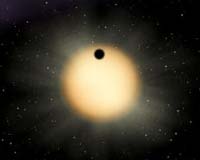
Flagstaff, AZ (SPX) Jun 13, 2007 An international team of astronomers with the Trans-atlantic Exoplanet Survey today announce the discovery of their third planet, TrES-3. The new planet was identified by astronomers looking for transiting planets - that is, planets that pass in front of their home star - using a network of small automated telescopes in Arizona, California, and the Canary Islands. TrES-3 was discovered in the constellation Hercules about 10 degrees west of Vega, the brightest star in the summer skies. "TrES-3 is an unusual planet as it orbits its parent star in just 31 hours!," said Georgi Mandushev, Lowell Observatory astronomer. "That is to say, the year on this planet lasts less than one and a third days. It is also a very massive planet - about twice the mass of the solar system's biggest planet, Jupiter - and is one of the planets with the shortest known periods." The new planet TrES-3 was first noticed by Lowell Observatory's Planet Search Survey Telescope (PSST), set up and operated by Edward Dunham and Georgi Mandushev. The Sleuth telescope, maintained by David Charbonneau (CfA) and Francis O'Donovan (Caltech), at Caltech's Palomar Observatory also observed transits of TrES-3, confirming the initial detections. TrES-3 is about 800 light-years distant and because it is so close to its host star, it is very hot, about 1,500 degrees Kelvin. "TrES-3 will be an intriguing object to study more deeply, said Edward Dunham, Lowell Observatory instrument scientist. "For example, its tight orbit causes it to be illuminated very strongly. This may make it possible to measure the variation in reflected light as it goes through its phases. This will tell us how reflective its atmosphere is." By definition, a transiting planet passes directly between Earth and the star, causing a slight dimming of the star's light in a manner similar to that caused when the moon passes between the Sun and Earth during a solar eclipse. To look for transits, the small telescopes are automated to take wide-field timed exposures of the clear skies on as many nights as possible. When an observing run is completed for a particular field - usually over an approximate two-month period - astronomers measure very precisely the light from every star in the field in order to detect the possible signature of a transiting planet. "TrES-3 blocks off about 2.5 percent of the light of the star as it passes in front of it," said Mandushev. "With our telescopes, we can measure this tiny drop in the star's brightness and deduce the presence of a planet there." TrES-3 was also observed by members of the Hungarian Automated Telescope Network (HATNet). The study's lead author, Francis O'Donovan of Caltech, highlighted the teamwork between TrES and HAT. "The search for extrasolar planets is an exciting and competitive field. I was happy to see that cooperation between separate teams led to a rapid confirmation of this planet," said O'Donovan. In order to help confirm they had found a planet, HATNet's Gaspar Bakos and CfA's Guillermo Torres switched from the 10-centimeter TrES telescopes to one of the 10-meter telescopes at the W. M. Keck Observatory on the summit of Mauna Kea, Hawaii. Using this giant telescope, they confirmed that they had found a new planet. In order to measure accurately the size and other properties of TrES-3, astronomers also made follow up observations of it with bigger telescopes at Lowell Observatory and Fred L. Whipple Observatory in Arizona, and with the Las Cumbres Observatory Global Telescope in Hawaii. Other authors of the paper "TrES-3: A Nearby, Massive, Transiting Hot Jupiter in a 31-hour Orbit," accepted for publication in the Astrophysical Journal, are Gaspar Bakos, David Charbonneau, David Latham, Alessandro Sozzetti, Robert Stefanik, and Guillermo Torres of the Harvard-Smithsonian Center for Astrophysics; Timothy Brown, Nairn Baliber, and Marton Hidas of the Las Cumbres Observatory Global Telescope; Geza Kovacs of Konkoly Observatory in Hungary; Mark Everett and Gilbert Esquerdo of the Planetary Science Institute; Markus Rabus, Hans Deeg, and Juan Belmonte of the Instituto de Astrofisica de Canaries in Tenerife, Spain; and Lynne Hillenbrand of the California Institute of Technology. The paper is available online at: http://arxiv.org/abs/0705.2004. Community Email This Article Comment On This Article Related Links Lowell Observatory Lands Beyond Beyond - extra solar planets - news and science Life Beyond Earth
 Spitzer Nets Thousands Of Galaxies In A Giant Cluster
 Greenbelt MD (SPX) Jun 13, 2007
In just a short amount of time, NASA's Spitzer Space Telescope has bagged more than a thousand previously unknown dwarf galaxies in a giant cluster of galaxies. Despite their diminutive sizes, dwarf galaxies play a crucial role in cosmic evolution. Astronomers think they were the first galaxies to form, and they provided the building blocks for larger galaxies. |
|
|

| The content herein, unless otherwise known to be public domain, are Copyright 1995-2006 - SpaceDaily.AFP and UPI Wire Stories are copyright Agence France-Presse and United Press International. ESA PortalReports are copyright European Space Agency. All NASA sourced material is public domain. Additionalcopyrights may apply in whole or part to other bona fide parties. Advertising does not imply endorsement,agreement or approval of any opinions, statements or information provided by SpaceDaily on any Web page published or hosted by SpaceDaily. Privacy Statement |