
. Military Space News .
FARM NEWS
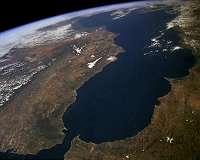
Mediterranean fears bitter future for citrus crops
By Isabel MALSANG
Paris (AFP) April 25, 2018

Could we soon be forced to do without a glass of orange juice or a slice of grapefruit at breakfast? The answer is unfortunately yes.

After decimating orange groves in Florida and trees in California and Brazil, citrus greening disease now threatens the key producing region of the Mediterranean, according to researchers.

The disease "has spread since the mid-2000s with a phenomenal speed and impact," said Eric Imbert of CIRAD, an agricultural research centre based in the French city of Montpellier.

The only citrus producing region as yet unafflicted, "the Mediterranean can't remain untouched by citrus greening disease," the researcher added.

Imbert said one species of the insect which spreads the disease has already been found on the Arabian peninsula.

The disease emerged in the first half of the last century in Asia, where it is called yellow dragon disease by the Chinese.

It is spread by small insects called plant lice or psyllids which jump from tree to tree to suck the sap. When they do they introduce the bacteria which ends up blocking the channels along which the sap flows.

As the bacteria chokes off the flow of nutrients the leaves turn yellow, the fruit is deformed, and eventually the tree dies.

The African psyllid, which spreads a less virulent form of the disease, has already been detected in northern Spain and in Portugal, where trees were rapidly uprooted to prevent any further spread.

- 'Screaming in a desert' -

"While not wanting to panic ... if we don't do anything in terms of prevention, we could end up suffering a major catastrophe, with prices doubling or tripling," said Imbert.

What happened in Florida proves he may well be right.

The Sunshine State saw its orange production tumble by 60 percent from 2005 to 2017.

And as production costs soared, the wholesale price of concentrated orange juice more than doubled to $2,500 per tonne.

"We are not immune from a phenomenon of similar magnitude on the Mediterranean fresh citrus market," Imbert said.

According to the trade magazine FruitTrop, just over one fifth of the oranges, clementines and lemons consumed in the world come from the Mediterranean region. It accounts for 70 percent of the world's exports of citrus fruits.

"Researchers hit the alarm button long ago," said Imbert, trying to get the attention of European authorities in particular. "But we have the impression we are screaming in a desert."

- 'Incredibly damaging' -

Countries around the world are trying different methods to combat the spread of citrus greening disease.

Brazil, a major exporter of orange juice, has relied heavily on pesticides.

In California, farmers have gone with an expensive option -- uprooting their sick trees and replanting.

Farmers in Florida were only able to use limited amounts of pesticide as their groves are located close to residential areas.

Moreover, their orange groves were already weak after being ravaged by several hurricanes, which meant the trees succumbed to the disease even more quickly.

Should lice carrying the virulent strain of citrus greening disease arrive in the Mediterranean region, experts expect it to spread rapidly, as it will also be difficult to use pesticides extensively.

"There a lots of small farms surrounded by residential areas," said Imbert.

Rushing to get ahead of the game, researchers are trying various approaches to combat the disease.

With the French Caribbean island of Guadeloupe already infested, French researchers have gained valuable experience.

"Today Guadeloupe has to import limes for ti'punch as over several years it has lost nearly all of its citrus trees," said Yann Froelicher, a researcher at the INRA national agricultural research institute, referring to a rum-based drink popular in the Caribbean.

"It was incredibly damaging as there were family-owned groves everywhere and everyone had an orange tree in their garden."

The researchers suspect nurseries were the reason the disease spread so quickly as seedlings infected in greenhouses were distributed across the island.

- 'No miracle solution' -

The response has been to ship in seeds from a repository that INRA runs on the Mediterranean island of Corsica which has a collection of some 10,000 citrus varieties.

Once on Guadeloupe they are grown in special greenhouses that are made insect proof before being sold to growers.

A type of small wasp that attacks the lice that spread the disease has also been released.

But studying the bacteria to directly combat citrus greening disease has proved hard because "you can't cultivate it in the laboratory," said Raphael Morillon, a researcher at CIRAD in Guadeloupe.

Researchers meet every two years in Orlando, Florida to review their efforts.

"The Americans boast of having solutions, but last year everyone was guarded, no one speaks of a miracle solution," said Morillon.

So far only France's Indian Ocean island Reunion seems to have found a way to keep the disease at bay: replanting at higher altitudes where the lice haven't yet followed.


Related Links
Farming Today - Suppliers and Technology


Thanks for being here;
We need your help. The Space Media Network continues to grow but revenues have never been harder to maintain.

With the rise of Ad Blockers, and Facebook - our traditional revenue sources via quality network advertising continues to decline. And unlike so many other news sites, we don't have a paywall - with those annoying usernames and passwords.

Our news coverage takes time and effort to publish 365 days a year.

If you find our news sites informative and useful then please consider becoming a regular supporter or for now make a one off contribution.
SpaceMediaNetwork Contributor
$5 Billed Once


credit card or paypal
SpaceMediaNetwork Monthly Supporter
$5 Billed Monthly


paypal only


FARM NEWS
South Africa wine production drying up in water crisis
Paris (AFP) April 24, 2018
South Africa is set for a steep decline in wine production in 2018 as the country grapples with a water crisis ravaging Cape Town and surrounding areas, a Paris-based global organisation said Tuesday. Africa's top wine producer is set to produce 8.6 million hectolitres of wine this year, down 20.4 percent down from 2017, the International Organisation of Vine and Wine (OIV) said in a statement. The Western Cape region has gone without significant rains for more than three years, forcing South Af ... read more

Comment using your Disqus, Facebook, Google or Twitter login.


Share this article via these popular social media networks
del.icio.usdel.icio.us DiggDigg RedditReddit GoogleGoogle

FARM NEWS
Saudis down new missile from Yemen rebels: state media

Saudis intercept ballistic missile from Yemen: coalition

Lockheed tapped for upgrades to Patriot, THAAD missile systems

Syrian air defence shoots down missiles over Homs: state media

FARM NEWS
US Strategic Command observed Russia, China operating hypersonic missiles

Syria retracts report on missile attack: state media

Lockheed tapped for long-range, anti-ship missiles

Boeing to restart production of Standoff Land Attack Missiles

FARM NEWS
MSAB and URSA Partner on Drone Forensic Technology

Air Force contracts with SRC for drone supplies, services

OFFSET "Sprinters" to Pursue State-of-the-art Solutions for Second Swarm Sprint

Israeli drone crashes in southern Lebanon

FARM NEWS
Russia Launches Heavy Rocket with Military Satellite

India Struggling to Establish Lost Link With Crucial Communication Satellite

Indian scientists lose contact with satellite

Russian Soyuz launches military satellite

FARM NEWS
In New Guinea, human thigh bone daggers were hot property: study

Army researchers conduct first-ever combustion experiment with X-rays

Orbital ATK receives $115M to produce Army ammunition

State Dept. approves $1.3B sale of Howitzers to Saudi Arabia

FARM NEWS
US to update Saudi artillery for $1.31 billion

74% of French people against weapons sales to Saudi: poll

Mattis wins big with budget victory

US approves $1 billion in Saudi defense contracts

FARM NEWS
Turkey to consider Greek soldiers' case if coup suspects returned

US-China trade tension dominates IMF gathering

Chinese ship conducting research near disputed islets: Japan

NATO not planning to boost military presence in Baltics

FARM NEWS
This 2-D nanosheet expands like a Grow Monster

A treasure trove for nanotechnology experts

UCLA researchers develop a new class of two-dimensional materials

Nanostructures made of previously impossible material


The content herein, unless otherwise known to be public domain, are Copyright 1995-2024 - Space Media Network. All websites are published in Australia and are solely subject to Australian law and governed by Fair Use principals for news reporting and research purposes. AFP, UPI and IANS news wire stories are copyright Agence France-Presse, United Press International and Indo-Asia News Service. ESA news reports are copyright European Space Agency. All NASA sourced material is public domain. Additional copyrights may apply in whole or part to other bona fide parties. All articles labeled "by Staff Writers" include reports supplied to Space Media Network by industry news wires, PR agencies, corporate press officers and the like. Such articles are individually curated and edited by Space Media Network staff on the basis of the report's information value to our industry and professional readership. Advertising does not imply endorsement, agreement or approval of any opinions, statements or information provided by Space Media Network on any Web page published or hosted by Space Media Network. General Data Protection Regulation (GDPR) Statement Our advertisers use various cookies and the like to deliver the best ad banner available at one time. All network advertising suppliers have GDPR policies (Legitimate Interest) that conform with EU regulations for data collection. By using our websites you consent to cookie based advertising. If you do not agree with this then you must stop using the websites from May 25, 2018. Privacy Statement. Additional information can be found here at About Us.