|
 |
 |
 |
 |
 |
 |
 |
 |
 |

| . |  |
. |
Mercury After 33 Years Of Distant Glimpses
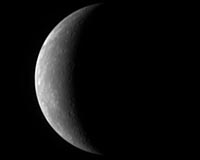
Laurel MD (APL) Jan 14, 2008 Today, January 14, 2008, at 19:04:39 UTC (2:04:39 pm EST), MESSENGER will experience its closest approach to Mercury, passing just 200 kilometers (124 miles) above the planet's surface. As the MESSENGER spacecraft continues to speed toward Mercury, the Narrow Angle Camera, part of the Mercury Dual Imaging System (MDIS) instrument, acquired this crescent view of Mercury. The image was taken on January 13, 2008, when the spacecraft was at a distance of about 760,000 kilometers (470,000 miles) from Mercury. Mercury is about 4880 kilometers (about 3030 miles) in diameter, and the smallest feature visible in this image is about 20 kilometers (12 miles) across. During the historic flyby encounter today, extensive scientific data will be gathered. The MDIS instrument will acquire over 1200 images of Mercury, including images of portions of the surface never before viewed by a spacecraft. The MDIS instrument is just one member of a whole suite of instruments that will be used to study Mercury during the flyby. The Mercury Atmospheric and Surface Composition Spectrometer (MASCS) will observe Mercury's surface as well as its tenuous atmosphere. The MESSENGER Magnetometer (MAG) will accurately measure Mercury's magnetic field, and the Energetic Particle and Plasma Spectrometer (EPPS) will characterize Mercury's space environment and interactions with the solar wind. The Mercury Laser Altimeter (MLA) will sense surface topography along a narrow profile. The Gamma-Ray and Neutron Spectrometer (GRNS) and X-Ray Spectrometer (XRS) will make the first measurements of Mercury"s surface elemental composition. MESSENGER will begin to transmit the new data to Earth once all of the scientific measurements are completed, about 22 hours after the spacecraft's closest approach to Mercury. These flyby data will shed light on fundamental scientific questions related to the formation and evolution of the planet Mercury. As scientists analyze the data, the MESSENGER spacecraft will continue on its planned journey, which includes two more encounters of Mercury in October 2008 and September 2009, before entering an orbit around Mercury in March 2011. Community Email This Article Comment On This Article Related Links Messenger at APL News Flash at Mercury Mars News and Information at MarsDaily.com Lunar Dreams and more
 MESSENGER All Set For Historic Mercury Flyby
 Washington DC (SPX) Jan 14, 2008
Today NASA will return to Mercury for the first time in almost 33 years, when the MESSENGER spacecraft makes its first flyby of the Sun's closest neighbor, capturing images of large portions of the planet never before seen. The probe will make its closest approach to Mercury at 2:04 p.m. EST today, skimming 200 kilometers (124 miles) above its surface. This encounter will provide a critical gravity assist needed to keep the spacecraft on track for its 2011 orbit insertion around Mercury. |
|
|

| The content herein, unless otherwise known to be public domain, are Copyright 1995-2007 - SpaceDaily.AFP and UPI Wire Stories are copyright Agence France-Presse and United Press International. ESA Portal Reports are copyright European Space Agency. All NASA sourced material is public domain. Additional copyrights may apply in whole or part to other bona fide parties. Advertising does not imply endorsement,agreement or approval of any opinions, statements or information provided by SpaceDaily on any Web page published or hosted by SpaceDaily. Privacy Statement |