|
 |
 |
 |
 |
 |
 |
 |
 |
 |

| . |  |
. |
Messenger Flies By Venus And Snaps Some Nice Pixs
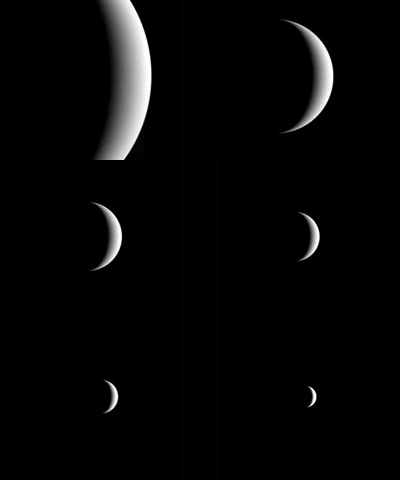
Laurel MD (SPX) Jun 15, 2007 The Messenger spacecraft snapped a series of images as it approached Venus on June 5. The planet is enshrouded by a global layer of clouds that obscures its surface to the Messenger Dual Imaging System (MDIS) cameras. This single frame is part of a color sequence taken to help the Messenger team calibrate the camera in preparation for the spacecraft's first flyby of Mercury on January 14, 2008. Over the next several months the camera team will pore over the 614 images taken during this Venus encounter to ascertain color sensitivity and other optical properties of the instrument. These tasks address two key goals for the camera at Mercury: understanding surface color variations and their relation to compositional variations in the crust, and ensuring accurate cartographic placement of features on Mercury's surface. Preliminary analysis of the Venus flyby images indicates that the cameras are healthy and will be ready for next January's close encounter with Mercury. After acquiring hundreds of high-resolution images during close approach to Venus, Messenger turned its wide-angle camera back to the planet and acquired a departure sequence. These images provide a spectacular good-bye to the cloud-shrouded planet while also providing valuable data to the camera calibration team. The first image was taken June 6 at 12:58 UTC (8:58 p.m. EDT on June 5), and the final image on June 7 at 02:18 UTC (10:18 p.m. EDT on June 6). During this 25 hour, 20 minute period the spacecraft traveled 833,234 kilometers (517,748 miles-more than twice the distance from the Earth to the moon) with respect to Venus at an average speed of 9.13 kilometers per second (5.67 miles per second).
earlier related report The MDIS consists of wide-angle and narrow-angle cameras that will map landforms, track variations in surface spectra, and gather topographic information at Mercury. It snapped a series of images as it approached Venus. "Venus is enshrouded by a global cloud layer that obscures its surface to the MDIS," explains Arizona State University's Mark Robinson, a Messenger science team member. "This single frame is part of a color sequence taken inbound to help us calibrate the wide-angle camera in preparation for its first flyby of Mercury next January. "Over the next several months the camera team will pore over the 614 images taken during the Venus 2 encounter to adjust color sensitivity parameters and better understand the geometric properties of the instrument." Robinson says that both tasks address two key goals for the instrument once the spacecraft gets to Mercury: understanding surface color differences and their relation to compositional variations in the crust; and ensuring accurate cartographic placement of features on Mercury's surface. "Preliminary analysis of the Venus flyby images indicates that the cameras are healthy and will be ready for next January's close encounter with Mercury," he says. After acquiring hundreds of high-resolution images during close approach to Venus, Messenger turned its wide-angle camera back to the planet and acquired a departure sequence. The first image was taken June 6 at 12:58 UTC (8:58 p.m. EDT on June 5), and the final image on June 7 at 02:18 UTC (10:18 p.m. EDT on June 6). During this 25 hour, 20 minute period the spacecraft traveled 833,234 kilometers (517,748 miles-more than twice the distance from the Earth to the Moon) with respect to Venus at an average speed of 9.13 kilometers per second (5.67 miles per second). "These images provide a spectacular good-bye to the cloud-shrouded planet while also providing valuable data to the camera calibration team," says Robinson. "As a gravity assist and dress rehearsal for Mercury, Messenger's Venus flyby was a huge success," said Messenger principal investigator Sean Solomon, from the Carnegie Institution of Washington. "The spacecraft hit its aim point to within 1.3 kilometers (0.81 miles), removing the need for another trajectory correction in July. Every instrument returned data from the Venus encounter, and the Science Team is hard at work analyzing the new observations. We plan to release further data as fast as we can." Community Email This Article Comment On This Article Related Links Messenger at APL Venus Express News and Venusian Science
 Venus Express And MESSENGER To Look At Venus In Tandem
 Paris, France (ESA) Jun 05, 2007
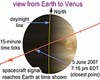
On 6 June this year, scientists all around the world will be watching with eager eyes as not one but two spacecraft observe Venus simultaneously. ESA's Venus Express, in orbit around Venus since 11 April 2006, will be joined for a few hours by NASA's MESSENGER (MErcury Surface Space ENvironment GEochemistry and Ranging mission), flying by Venus while on its way to Mercury. |
|
|

| The content herein, unless otherwise known to be public domain, are Copyright 1995-2006 - SpaceDaily.AFP and UPI Wire Stories are copyright Agence France-Presse and United Press International. ESA PortalReports are copyright European Space Agency. All NASA sourced material is public domain. Additionalcopyrights may apply in whole or part to other bona fide parties. Advertising does not imply endorsement,agreement or approval of any opinions, statements or information provided by SpaceDaily on any Web page published or hosted by SpaceDaily. Privacy Statement |