|
 |
 |
 |
 |
 |
 |
 |
 |
 |

| . |  |
. |
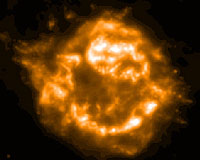
Messenger Stares At Supernova Remnant Cassiopeia A
Greenbelt MD (SPX) Feb 16, 2005 Messenger's X-Ray Spectrometer (XRS) instrument underwent calibrations last week, spending five days "looking" at one of the stronger x-ray sources in the sky, the supernova remnant Cassiopeia A. The test gives the XRS team its best look yet at the instrument's detectors, allowing them to measure how well its anti-coincidence and pulse shape discrimination circuits eliminate background signals from x-ray measurements. "Background rejection is important because it improves the signal-to-background ratio, thereby increasing the sensitivity of the XRS measurements," says Richard Starr, XRS instrument lead scientist, from NASA Goddard Space Flight Center. "We expect this observation of Cas-A to provide more reliable data than ground measurements on how well the background rejection is working." The team will spend the next several weeks analyzing the test data and hopes to observe Cassiopeia A again during the cruise to Mercury to track the X-Ray Spectrometer's performance. XRS wasn't the only part of the science payload to get a workout last week; the team also turned on the Mercury Atmospheric and Surface Composition Spectrometer (MASCS) Feb. 7 for two days of maintenance operations.
Smooth Steering On Feb. 4 the spacecraft team performed a successful steering test on the back phased-array antenna. Messenger is the first deep space mission to use an electronically steered phased-array antenna. Two phased arrays, mounted on opposite sides of the spacecraft, provide Messenger's high-gain downlink coverage.
Stat Corner Messenger is about 91 million miles (146.5 million kilometers) from the Sun and 30.6 million miles (49.2 million kilometers) from Earth. At that distance, a signal from Earth reaches the spacecraft in 2 minutes, 44 seconds. The spacecraft is moving around the Sun at 67,981 (109,404 kilometers) per hour. Messenger's onboard computers have executed 28,608 commands from mission operators since launch. Related Links Messenger at NASA SpaceDaily Search SpaceDaily Subscribe To SpaceDaily Express  New Measurement Undermines Physicists' Theories For Hidden 'Particle-Force'
 Rochester NY (SPX) Feb 14, 2005
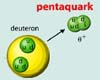
A new measurement by a student and professor at the University of Rochester has shed new light on the limits of scientists' standard model of physics. |
|
|

| The content herein, unless otherwise known to be public domain, are Copyright 1995-2006 - SpaceDaily.AFP and UPI Wire Stories are copyright Agence France-Presse and United Press International. ESA PortalReports are copyright European Space Agency. All NASA sourced material is public domain. Additionalcopyrights may apply in whole or part to other bona fide parties. Advertising does not imply endorsement,agreement or approval of any opinions, statements or information provided by SpaceDaily on any Web page published or hosted by SpaceDaily. Privacy Statement |