|
 |
 |
 |
 |
 |
 |
 |
 |
 |

| . |  |
. |
Meteorite Crater Drilling Provides Extensive Samples - And A Mystery
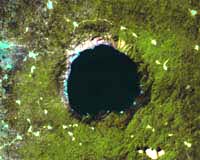
Vienna, Austria (SPX) Oct 21, 2004 Drillings made in the Bosumtwi crater in Ghana, one of the youngest meteorite craters in the world, led to yet another mysterious finding - the rock formation caused by the heat of the meteoric impact is only half as thick as expected. This is the first result from a large international drilling project, which will provide new information simultaneously to both the earth and climate sciences as a result of detailed planning. The technically very demanding drilling operations were carried out during the past weeks by a multi-national team led by an Austrian scientist, partially funded by the Austrian Science Fund (FWF) within the International Continental Drilling Program (ICDP). Over 2.2 km of drill core have been retrieved and that will provide important material for detailed analyses. The Bosumtwi crater in Ghana (West Africa) is interesting in many respects. First of all, at an age of one million years it is one of the youngest and best preserved impact craters on earth. Second, along with only three other of the total 170 known impact craters on earth, it is associated with a special geological feature - during the impact the uppermost rock layers were melted and formed glass (so-called tektites), which are scattered over a distance of over 1000 kilometres.
Climatic Archive Under Water However, it is the third aspect that makes the Bosumtwi crater particularly interesting - an eight-kilometre wide lake that fills the 11-km-diameter crater. The Austrian principal investigator, Prof. Christian Koeberl of the Department of Geological Sciences, University of Vienna, explains the significance of this lake: "Sediments have been deposited in this lake for a million years. According to the season, the sediment input is dominated by the Atlantic monsoon or by the dust from the Sahel and Sahara. Thus, this sedimentary layer offers a comprehensive archive of the climate of the last one million years in West Africa." This sedimentary layer now overlies the rocks formed by the meteoritic impact. A two-step approach was taken to study both the climate record contained in the lake sediments and the rocks that formed during the meteorite impact event. The research team comprising members of seven nations has been drilling from June to October 2004. First, a U.S.-led part of the team extracted lake sediment cores. Fourteen cores from six locations yielded a total of 1850 metres of core samples, spanning the whole million-year climate history contained in the lake sediments. The logistically very challenging drilling in the impact-derived rocks began under Prof. Koeberl's management at the end of August. Prof. Koeberl explained the difficult logistics, which were supported by the International Continental Scientific Drilling Program (ICDP): "In order to satisfy all the requirements of the project, our team comprised up to 10 drilling engineers, 10 geophysicists and 11 people just for the scientific analysis on site. Moreover, in such a remote area as the Bosumtwi crater, the efficient coordination of such a technically demanding project presented special scientific and logistical challenges. For example, to allow the launching and loading our floating drilling platform, we had to construct part of a road and a special pier." However the effort proved worthwhile; within just five weeks the team managed to drill at two locations through the sedimentary layer and into the impact-derived rock to depths of 540 and 452 metres, respectively. This yielded over 350 m of "hard rock" core. Preliminary studies of the available cores resulted in a big surprise - the layer with "impact melt rock", which formed by melting of country rock during the meteorite impact, is not as thick as expected from previous geophysical studies. But only the detailed analysis of all the samples in the 122 core boxes, which are currently on their way to Europe, will hopefully deliver the answer to the question - why? Related Links University of Vienna SpaceDaily Search SpaceDaily Subscribe To SpaceDaily Express  Multiple Impacts?
 Moffett Field CA (SPX) Oct 21, 2004
Rather than a single meteorite impact 65 million years ago, could Earth have been hit with a scattershot of several rocks from space? It may have happened before. |
|
|

| The content herein, unless otherwise known to be public domain, are Copyright 1995-2006 - SpaceDaily.AFP and UPI Wire Stories are copyright Agence France-Presse and United Press International. ESA PortalReports are copyright European Space Agency. All NASA sourced material is public domain. Additionalcopyrights may apply in whole or part to other bona fide parties. Advertising does not imply endorsement,agreement or approval of any opinions, statements or information provided by SpaceDaily on any Web page published or hosted by SpaceDaily. Privacy Statement |