
 |
 |
 |
 |
 |
 |
 |
 |
 |
 |

| . |  |
. |

Science@NASA Huntsville AL (SPX) Apr 28, 2011 Looking for an adventure? Get up in the wee hours of the morning May 6th and head out into the country, far from the city lights. You won't be alone. The birds will be up and singing about the coming dawn, and, of course, about the eta Aquarid meteor shower. The eta Aquarids are best viewed from the southern hemisphere, but there's something special about them no matter where you live: "Each eta Aquarid meteoroid is a piece of Halley's Comet doing a kamikaze death dive into the atmosphere," explains NASA astronomer Bill Cooke. "Many people have never seen this famous comet, but on the morning of May 6th they can watch bits of it leave fiery trails across the sky." A messenger from the dawn of the universe, Halley's Comet orbits the sun once every 76 years. Each time it swings by the sun, intense solar heat vaporizes about 6 meters of ice and rock from the nucleus. The debris particles, about the size of sand grains, spread along the comet's orbit, filling it with tiny meteoroids. "Although Halley's Comet is deep in the outer solar system at the moment and won't return to Earth until 2061, it treats us to a meteor shower twice a year as our planet passes by the debris cloud," says Cooke. "In May we have the eta Aquarids, and in October the Orionids." And there is something especially significant about the 2011 eta Aquarids. "This is your one chance this year to see meteors blaze across the sky without glaring moonlight dimming them." A thin crescent moon will vacate the sky in the early evening, leaving a dark canvas for the display. Early risers are in luck, as the best viewing is an hour or two before dawn. Lie down where you can see as wide an expanse of sky as possible to catch more meteors with your peripheral vision. Look up into the darkness and relax. The radiant for the eta Aquarids is in the constellation Aquarius: diagram. But you don't need to look toward the radiant to see the meteors. "Meteors can appear in any part of the sky," says Cooke. "In fact their trails will tend to point back toward the radiant, so if you look that way the meteor may appear somewhat stubby. They'll appear much longer going by you than coming at you." You won't need binoculars or a telescope to observe eta Aquarid meteors. The naked eye's field of view is usually best for seeing meteors, which frequently streak more than 45 degrees across the sky. "Eta Aquarids are fast, moving at 66 km/s (148,000 mph!), and often trace long paths across the sky, sometimes leaving glowing, persistent trains. In the northern hemisphere, depending on your latitude [the closer to the equator the better], you should see from 10 to 40 meteors just before dawn." Remember to pack a reclining chair or an old blanket to lie on, and a thermos of hot coffee would be nice. After all, you'll be up mighty early! The spring night air may be damp and chill, so bring along another blanket--or better yet, a big furry dog, both for warmth and company. Golden Retrievers work nicely. It's sure to be a memorable experience. A night breeze caressing your cheek, the aroma of hot coffee in the predawn air, a gently rising chorus of birdsong accompanying your own personal light show - and your greatest admirer by your side. It just doesn't get any better.
Share This Article With Planet Earth
Related Links - Asteroid and Comet Mission News, Science and Technology

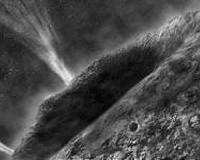 Frozen Comet Had A Watery Past
Greenbelt MD (SPX) Apr 06, 2011 The discovery of minerals requiring liquid water for their formation challenges the paradigm of comets as "dirty snowballs" frozen in time. For the first time, scientists have found convincing evidence for the presence of liquid water in a comet, shattering the current paradigm that comets never get warm enough to melt the ice that makes up the bulk of their material. "Current thinking sug ... read more |
|
|
| The content herein, unless otherwise known to be public domain, are Copyright 1995-2010 - SpaceDaily. AFP and UPI Wire Stories are copyright Agence France-Presse and United Press International. ESA Portal Reports are copyright European Space Agency. All NASA sourced material is public domain. Additional copyrights may apply in whole or part to other bona fide parties. Advertising does not imply endorsement,agreement or approval of any opinions, statements or information provided by SpaceDaily on any Web page published or hosted by SpaceDaily. Privacy Statement |


 del.icio.us
 Digg
Digg Reddit
 YahooMyWeb
 Google
 Facebook


