
Subscribe free to our newsletters via your
. Military Space News .


BIO FUEL
Microalgae Capable Of Assimilating The Ammonium From Agri-Food Waste
by Staff Writers
Basque Region, Spain (SPX) Jun 02, 2014


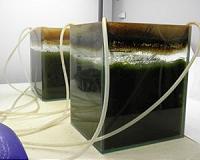
Chlamydomonas acidophila microalgae display characteristics suited to growing and reproducing in a medium that contains up to 50% of the liquid that comes from the decomposition of agri-food waste

The Basque Institute for Agricultural Research and Development, Neiker-Tecnalia, the public body that reports to the Sub-Ministry for Agriculture, Fisheries and Food Policy of the Government of the Basque Autonomous Community, has confirmed the capacity of Chlamydomonas acidophila microalgae to absorb ammoniacal nitrogen present in the effluent generated in the digestion of organic waste coming from the agri-food sector.

These algae can grow in these liquids and assimilate the ammonium, which prevents this gas from being volatilised in the form of ammonia (NH3) and contaminating the atmosphere. Furthermore, the microalgae biomass obtained in this procedure can be used as a raw material for producing biogas or used as animal feed, compost or fertilizer besides being an extraordinary source of lutein, a powerful antioxidant used as a food supplement.

The decomposition process of agri-food waste in oxygen-free conditions produces effluent that has a high content of ammoniacal nitrogen, specifically between 2 and 5 grams per litre. Significant quantities of this waste is produced on farms and biogas plants, among other facilities. That is why it is essential to find suitable methods for managing it and for preventing the ammonia from being volatilised and ending up in aquifers and surface waters.

Chlamydomonas acidophila microalgae display characteristics suited to growing and reproducing in a medium that contains up to 50% of the liquid that comes from the decomposition of agri-food waste, as Neiker-Tecnalia researchers have been able to confirm. The main advantage in cultivating them lies in their capacity to develop in very acid mediums (pH 2-3) and to tolerate, to a high degree, the presence of heavy metals and high organic loads.

In addition to their environmental contribution owing to their capacity to assimilate ammoniacal nitrogen, they have a significant capacity to produce lutein, a powerful antioxidant that helps to delay cell and tissue deterioration and oxidation; lutein protects the organism from free radicals attack and is used in various therapeutic treatments.

Optimum consumption of it leads to better vision, prevents cataract progression and also accumulates a large quantity of carotenoids -organic pigments- of commercial interest for the food industry.

Neiker-Tecnalia is currently developing various lines of research devoted to identifying and subsequently assessing microalgae strains that are of commercial and environmental interest. Among the projects being conducted features the quest for oil-rich microalgae that can be used to obtain biodiesel.

Source of new products and applications
Microalgae form a heterogeneous group of microorganisms distributed across all imaginable environments and which share the characteristic of being photosynthetic. These organisms perform an essential role in global ecology since they are responsible for fixing about 50% of the planet's carbon.

Through photosynthesis they use solar energy to trap atmospheric carbon dioxide and turn it into organic carbon.

Due to their huge biodiversity, microalgae represent one of the most promising sources of new products and applications. Today, they are a source of a large variety of compounds and biomolecules with a high commercial value and applications as wide ranging as food, dietetics, fine chemicals, biomedicine, cosmetics and bioenergy, all of which are an indication of their biotechnological potential.

.


Related Links
Basque Research
Bio Fuel Technology and Application News


Comment on this article via your Facebook, Yahoo, AOL, Hotmail login.

Share this article via these popular social media networks
del.icio.usdel.icio.us DiggDigg RedditReddit GoogleGoogle


BIO FUEL
EU study assesses turning CO2 into methanol for use in transport
Madrid, Spain (SPX) May 28, 2014
Tecnalia has collaborated in a study for the European Parliament's Science and Technology Options Assessment Panel (STOA) on the future use of methanol, produced from carbon dioxide, in motorised transport. STOA is the panel that advises MEPs in the sphere of Science and Technology. The study analysed the barriers -technological, environmental and economic- to producing methanol using carb ... read more


BIO FUEL
US seeks greater missile defense cooperation by Japan, South Korea

Land-based variant of Aegis tested

Canadian missile defense radar to be operated, maintained by Raytheon

Propulsion Module For SBIRS GEO-4 Satellite Completed

BIO FUEL
Combined Diehl, Elbit missile counter-measures for Germany's A400Ms

British helicopters getting new missile warning system

Australian military gives JASSM final operational capability status

Lockheed Martin Demonstrates Javelin Firing From Turret in UK Test

BIO FUEL
Camcopter S-100S put through its paces

Nature inspires drones of the future

US drone deployed in Japan for first time

ATC coms system in works for Predator

BIO FUEL
NATO agency extends Globalcomms services

Rockwell supplying radios, satellite terminals to Canadian military

Exelis to help repair, modernize tactical radios

The U.S. Navy has contracted Harris Corporation for next-gen radios

BIO FUEL
Compact Indium Phosphide Ultra-Low-Noise Amplifiers For Military Use

US Veterans Affairs secretary resigns amid scandal

Latin American country orders security system from Elbit

BAE Systems offers vehicle in Army M113 replacement competition

BIO FUEL
New collaboration underway in Canada

'Significant delays' found in treatment of US veterans

Pentagon chief to take in Singapore, Europe next week

French PM vows to keep defence budget intact after warnings

BIO FUEL
NATO sees 'some signs' Russia troops leaving Ukraine border

US urges China to avoid tensions in airspace

Russia says Ukraine breaches Geneva Convention on protection of civilians

China to promote its security theory at Shangri-La

BIO FUEL
DNA nanotechnology places enzyme catalysis within an arm's length

Engineers build world's smallest, fastest nanomotor

Bending helps to control nanomaterials

Nanoscale heat flow predictions


The content herein, unless otherwise known to be public domain, are Copyright 1995-2014 - Space Media Network. All websites are published in Australia and are solely subject to Australian law and governed by Fair Use principals for news reporting and research purposes. AFP, UPI and IANS news wire stories are copyright Agence France-Presse, United Press International and Indo-Asia News Service. ESA news reports are copyright European Space Agency. All NASA sourced material is public domain. Additional copyrights may apply in whole or part to other bona fide parties. Advertising does not imply endorsement, agreement or approval of any opinions, statements or information provided by Space Media Network on any Web page published or hosted by Space Media Network. Privacy Statement All images and articles appearing on Space Media Network have been edited or digitally altered in some way. Any requests to remove copyright material will be acted upon in a timely and appropriate manner. Any attempt to extort money from Space Media Network will be ignored and reported to Australian Law Enforcement Agencies as a potential case of financial fraud involving the use of a telephonic carriage device or postal service.