. Military Space News .
Monitoring Rosetta's New Avionics Software

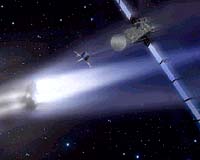
illustration only

Paris (ESA) Aug 05, 2004
In the reporting period (23 July to 30 July 2004) the spacecraft was monitored daily to ensure thecorrect behaviour of its avionics systems after the upload and activation of the new version 7 of the on-board software.

Taking the opportunity of this period of daily contact a number of tests were carried out, which in turn served as confidence checks of the functionality of the new software:

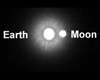
  • the two Navigation Cameras were checked out on 25 July and the first pictures received showed the Earth-Moon system from a distance of 70 million km.
  • for the first time the new strategy for reaction wheel offloading in an optimized attitude was used on 27 July, to reduce fuel consumption in high disturbance torques conditions.
  • the redundant Transfer Frame Generator (TFG) and Decoder were tested as part of the redundancy commissioning a special Star Tracker test was carried out on 29 July to track stars which have been identified for elimination from the catalogue.
  • a new thermal characterization exercise was carried out on 29 July, to observe the thermal behaviour of the spacecraft when the Sun is shining on the Z side with an inclination of 50 degrees over the +X axis.
  • The TC files containing the patch commands for the redundant avionics processors have been uplinked to the on-board mass memory. The patch of the redundant processors to the new software version 7 is planned for the beginning of August.

    At the end of the last New Norcia pass in the reporting period (DOY 212) Rosetta was at 71.9 million kilometres from the Earth. The one-way signal travel time was 3 minutes 59 seconds.

    Related Links
    Rosetta at ESA
    SpaceDaily
    Search SpaceDaily
    Subscribe To SpaceDaily Express

    Comet Cruiser Glimpses Earth
    Moffett Field CA (SPX) Aug 05, 2004
    The banner image, taken by ESA's Rosetta comet-chaser spacecraft, shows the Earth-Moon system from a distance of 70 million kilometers (42 million miles). This is close to the maximum distance reached by the spacecraft so far this year.


  • US Warned Not To Ignore Chinese Military Advances

  • Kashmir Violence Greets India-Pakistan Talks
  • Analysis UC's Los Alamos Contract At Stake
  • Analysis Iraq no longer in nuclear mix
  • Outside View: Rewarding China's Proliferation

  • Poll Reveals 83 Percent Of Floridians Want Missile Defense Protection
  • Denmark Agrees To Purchase Raytheon's AIM 9X Sidewinder Air-To-Air Missile
  • Aegis Weapon System Delivers Aboard US Navy Destroyer James E. Williams
  • European And Asian Firms Can Join Missile Defense Industry: NG CEO

  • First Missile Defense Interceptor Vehicle Emplaced In Alaska Silo
  • LockMart Delivers Aegis Weapon System To 50th Navy Destroyer
  • Northrop Grumman And EADS To Collaborate On Missile Defense
  • Analysis: A New Era Of Defense For Japan

  • NASA To Award Contract For Aerospace Testing
  • Sonic Boom Modification May Lead To New Era
  • Hewitt Pledges Support For Aerospace Industry
  • National Consortium Picks Aviation Technology Test Site

  • US Army Shadow Tactical UAV's Pass 8,800 Flight Hours In Iraq
  • US Army Shadow Tactical UAV's Pass 8,800 Flight Hours In Iraq
  • Sanswire Networks Starts Countdown To Launch
  • Teal Group Predicts UAV Market Will Double By 2014


  • Airbag Inflators Provide Push For New Surface Vessel Launcher
  • Russian Navy May Sink By 2008: Admiral

  • The content herein, unless otherwise known to be public domain, are Copyright 1995-2006 - SpaceDaily.AFP and UPI Wire Stories are copyright Agence France-Presse and United Press International. ESA PortalReports are copyright European Space Agency. All NASA sourced material is public domain. Additionalcopyrights may apply in whole or part to other bona fide parties. Advertising does not imply endorsement,agreement or approval of any opinions, statements or information provided by SpaceDaily on any Web page published or hosted by SpaceDaily. Privacy Statement