
. Military Space News .
SPACE MEDICINE
Monitoring the airways of space travelers
by Staff Writers
Paris (ESA) May 02, 2017


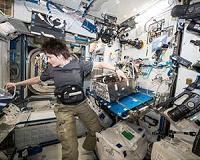
The experiment began with ESA astronaut Samantha Cristoforetti in 2015 and has tested six astronauts so far, aiming to finish with more astronauts by 2020.

Astronauts in space are valuable sources of scientific data. Researchers collect blood and urine samples to understand what effects living in weightlessness has on their bodies. For one experiment, investigators are interested in their breath.

The Karolinska Institutet in Stockholm, Sweden, is analysing astronauts' exhaled air to probe lung health. The results so far have been breathtaking.

The Airway Monitoring experiment measures the level of nitric oxide in astronauts' lungs, a naturally occurring molecule produced in the lungs to help regulate blood flow. Small amounts are normal, but excess levels indicate airway inflammation caused by environmental factors such as dust and pollutants or diseases like asthma.

Aboard the Station, astronauts breathe into an analyser at normal pressure and in the reduced pressure of the Quest airlock - similar to the pressure in future habitats on Mars and lunar colonies. The measurements are then compared to those taken before flight.

The experiment began with ESA astronaut Samantha Cristoforetti in 2015 and has tested six astronauts so far, aiming to finish with more astronauts by 2020.

Preliminary results are surprising. While nitric oxide levels were lower throughout astronauts' stays in space, as expected, they found that the levels initially decreased just before flight. Researchers are not yet sure why this is the case.

But the lower nitric oxide levels in astronauts' lungs means researchers have to reset the level considered to be 'healthy' for spaceflight.

If what is considered a normal level of nitric oxide in humans on Earth could in fact be a sign of airway inflammation for astronauts in space, researchers have a more accurate standard from which to conduct further research on lung health in space.

This information is key to ensuring the health and safety of astronauts on longer missions further from Earth. Understanding the effects of weightlessness and reduced pressure on airway health allows us to solve future problems. This in turn will help space explorers monitor, diagnose and treat lung inflammation during spaceflight.

For now, data from the remaining astronaut participants are needed before definitive conclusions can be made. But, overall, researchers have a better understanding of the lungs that will go a long way towards developing better diagnostic tools for airway diseases in patients on Earth.

SPACE MEDICINE
Medical guidelines for astronauts to be launched in the US
Plymouth UK (SPX) May 01, 2017
With Cassini making final preparations to penetrate Saturn's rings, and renewed interest in colonising the Moon and sending people to Mars, space flight and exploration are experiencing a level of interest not seen since the Apollo missions to the Moon in the late 60's and 70's, and the space shuttle programme of the 80's. Space travel and exploration have resulted in a variety of technolo ... read more

Related Links
ISS Research at ESA
Space Medicine Technology and Systems


Thanks for being here;
We need your help. The Space Media Network continues to grow but revenues have never been harder to maintain.

With the rise of Ad Blockers, and Facebook - our traditional revenue sources via quality network advertising continues to decline. And unlike so many other news sites, we don't have a paywall - with those annoying usernames and passwords.

Our news coverage takes time and effort to publish 365 days a year.

If you find our news sites informative and useful then please consider becoming a regular supporter or for now make a one off contribution.
SpaceMediaNetwork Contributor
$5 Billed Once


credit card or paypal
SpaceMediaNetwork Monthly Supporter
$5 Billed Monthly


paypal only


Comment using your Disqus, Facebook, Google or Twitter login.

Share this article via these popular social media networks
del.icio.usdel.icio.us DiggDigg RedditReddit GoogleGoogle

SPACE MEDICINE
THAAD missile defense system now operational in S. Korea

China demands halt to US missile shield in S.Korea

Seoul rejects Trump demand it pays for missile system

Syria to buy latest Russian anti-missile system: Assad

SPACE MEDICINE
Tokyo subway halt for 10 minutes over NKorea scare

Sweden orders additional anti-ship missiles from Saab

SM-6 missile completes final round of tests

Northrop to integrate missile countermeasure systems for Air Force, Navy

SPACE MEDICINE
Dutch production facility opens for Predator B landing gear

Lockheed flies long-range endurance test flights of Fury unmanned aircraft

Service Academies Swarm Challenge Live-Fly Competition Begins

MQ-8C Fire Scout takes first flight from littoral combat ship

SPACE MEDICINE
Airbus to carry out a definition study for the ground segment of the Syracuse IV

Information Assurance: The U.S. Military's Growing Need for What Commercial SATCOM Providers Offer

MUOS Satellite Now Supporting Troops with Ultra High Frequency Communications

Navy's New Satellite Network to Be Fitted With Advanced Data Transfer Gear

SPACE MEDICINE
Rheinmetall picks armaments services supplier Australian vehicle contract

BAE partners with Czech firm on mortar system

U.S. Army secures contract for up to 2,500 T700 turboshaft engines

Australian troops to receive Bertin-made chemical detectors

SPACE MEDICINE
Dutch court jails Charles Taylor arms-supplier for 19 years

Canada moves to join treaty curbing foreign arms sales

India inks weapons deal worth nearly $2 bn with Israel

U.S. lawmakers push for Pentagon reforms

SPACE MEDICINE
China's Xi hails ties with Philippines as Duterte cools on US

Funding for Eucom essential, NATO Supreme Commander tells U.S. Senate (SPX) May 04, 2017

Far-right plot, abuse scandals rock German military

Philippines' Duterte hesitant on US visit, warm on China

SPACE MEDICINE
Scientists set record resolution for drawing at the one-nanometer length scale

X-ray microscope optics resolve 50-nm features while eliminating chromatic aberrations

Self-assembled nanostructures can be selectively controlled

Nanotubes that build themselves


The content herein, unless otherwise known to be public domain, are Copyright 1995-2024 - Space Media Network. All websites are published in Australia and are solely subject to Australian law and governed by Fair Use principals for news reporting and research purposes. AFP, UPI and IANS news wire stories are copyright Agence France-Presse, United Press International and Indo-Asia News Service. ESA news reports are copyright European Space Agency. All NASA sourced material is public domain. Additional copyrights may apply in whole or part to other bona fide parties. All articles labeled "by Staff Writers" include reports supplied to Space Media Network by industry news wires, PR agencies, corporate press officers and the like. Such articles are individually curated and edited by Space Media Network staff on the basis of the report's information value to our industry and professional readership. Advertising does not imply endorsement, agreement or approval of any opinions, statements or information provided by Space Media Network on any Web page published or hosted by Space Media Network. General Data Protection Regulation (GDPR) Statement Our advertisers use various cookies and the like to deliver the best ad banner available at one time. All network advertising suppliers have GDPR policies (Legitimate Interest) that conform with EU regulations for data collection. By using our websites you consent to cookie based advertising. If you do not agree with this then you must stop using the websites from May 25, 2018. Privacy Statement. Additional information can be found here at About Us.