. Military Space News .


.
MOON DAILY
Moon's mountains made by slo-mo crash: study
by Staff Writers
Paris (AFP) Aug 3, 2011

When worlds collide...

The Moon's highlands, long a mystery, may have been thrown up billions of years ago by a slow-motion collision with a smaller companion moon knocked off its orbit, says a study released Wednesday.

With mountain ranges topping 3,000 metres (10,000 feet) and deep craters, the farside of the Moon bears scant resemblance to the smoother surface and shallow lava-filled maria, or "seas", on the nearside visible from Earth.

Scientists have proffered many explanations for this split personality, also known as the "lunar dichotomy".

Some point to uneven tidal heating, the process by which energy from rotation and orbit deform a planet's outer crust.

Others argue that lopsided bombardment by asteroids and comets explain our Moon's Janus-faced exterior.

But a pair of researchers from the University of California at Santa Cruz, Martin Jutzi and Erik Asphaug, have proposed a new storyline for the sculpting of the lunar landscape, one that reaches back to the Moon's very origins.

Their findings, published in Nature, tie up loose ends that other theories cannot account for, they said.

Not long after Earth took shape more than four billion years ago it was likely struck a glancing blow by a Mars-sized body, an event called the giant-impact hypothesis.

The Moon is thought to be composed of the debris cast off by that collision, which probably created other, smaller, moon-like bodies as well.

As our solar system evolved toward its current configuration, none of these lesser orbs were likely to have survived very long -- unless they landed in a sweet spot called an Earth-Moon Trojan point.

At least one such mini-moon, about a third the diameter of the one we see today, could have been suspended between the gravitational pulls of the Moon and Earth for tens of millions of years, they calculated.

Eventually, however, it would have lost its moorings and crashed into the Moon, which was covered at that point by a magma ocean topped by a crystallised crust.

At high speed, planet-scale collisions create monstrous craters and vast amounts of vaporised debris, mostly melted by the intense heat.

But because the mini-moon, due to its position, would have been moving at a much slower speed -- about two-to-three kilometres per second -- the impact would have left a rim of mountains.

"According to our simulations, a large 'moon-to-Moon' size ratio and a subsonic impact velocity lead to an accretionary pile rather than a crater," Jutzi and Asphaug concluded.

This scenario would also help explain why the farside's crust is so much thicker, and why certain minerals are concentrated there, the study said.

"The current study demonstrates plausibility rather than proof," MIT researcher Maria Zuber cautioned in a commentary, also in Nature, noting that the origins of the farside highlands have been "a topic of speculation since the first global measurements of the Moon's shape."

Because the rubble that became the mountains would have crystallised millions of years earlier than the Moon, examining the age of the soil would be one way to confirm the study, but no such samples are available.

The new theory could also be bolstered -- or challenged -- by data expected next year from the NASA's Lunar Reconnaissance Orbiter mission, as well as high-resolution gravity mapping to be done by the Agency's Gravity Recovery and Interior Laboratory (GRAIL).


Related Links
Mars News and Information at MarsDaily.com
Lunar Dreams and more

.
Get Our Free Newsletters Via Email
...
Buy Advertising Editorial Enquiries


Did Earth once have two moons?
Santa Cruz, Calif. (UPI) Aug 3, 2011 - Earth may have once had two moons that collided, leaving an asymmetry in our companion's shape that has long puzzled scientists, a U.S. researcher says.

In an article published this week in Nature, Erik Asphaug, a planetary scientist at the University of California, Santa Cruz, suggests the two bodies merged in a slow-motion collision lasting many hours that created a mysterious mismatch between the moon's visible side and its remote far side.

The moon's visible side is dominated by low-lying lava plains, while its far side is composed of highlands. The differences, however, go below the surface, as the thickness of the moon's crust and the minerals found below the surface vary between the two regions, Asphaug and co-author Martin Jutzi of the University of Bern said.

Asphaug suggests something squeezed some of the moon's layers to one side, and that a collision with a smaller moon about 600 miles in diameter is the most likely explanation.

"By definition, a big collision occurs only on one side," he says, "and unless it globally melts the planet, it creates an asymmetry."

Following the slow-motion impact, Asphaug says, gravity would have squeezed the material of the smaller body to a relatively thin layer on top of the moon's existing crust.


. Comment on this article via your Facebook, Yahoo, AOL, Hotmail login.

Share this article via these popular social media networks
del.icio.usdel.icio.us DiggDigg RedditReddit GoogleGoogle


MOON DAILY
Unique volcanic complex discovered on Lunar far side
St Louis MO (SPX) Jul 26, 2011
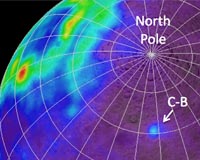
Analysis of new images of a curious "hot spot" on the far side of the Moon reveal it to be a small volcanic province created by the upwelling of silicic magma. The unusual location of the province and the surprising composition of the lava that formed it offer tantalizing clues to the Moon's thermal history. The hot spot is a concentration of a radioactive element thorium sitting between t ... read more


MOON DAILY
US destroys missile over Pacific in test

Israel tests advanced missile interceptor

US senators voice worry over radar deal with Turkey

New Missile Warning Satellite Delivers First Infrared Imagery

MOON DAILY
Lockheed Martin JASSM Lot 8 Software Validated During Flight Test

Iran says fired missiles into Indian Ocean

Northrop Grumman-Led ICBM Prime Integration Team Participates in Test Launch of Minuteman III Missile

Taiwan testfires own sub-launched missile: report

MOON DAILY
Japanese inventor develops flying sphere drone

HALE-D Demonstrated During Abbreviated Flight

Germany gets first Euro Hawk

Global Hawk Completes First Full System Flight With MP-RTIP Sensor

MOON DAILY
Raytheon Develops Miniature Antenna To Extend Millimeter Wave Friendly ID Technology

China launches another experimental satellite

USAF Approves Production of NGC Deployable Digital Wireless System for Remote Warfighters

Raytheon BBN Technologies Awarded DoD Contract to Develop a Secure, Attributed Military Network System

MOON DAILY
Fears for US Army bullet-proof vests over poor tests

Wire pops lock certified for US defense facilities

Japan's P-1 patrol aircraft faces delays

US Army Selects SMSS Autonomous Vehicle for Afghanistan Deployment

MOON DAILY
US-Bahrain defense pact renewed

Bulgaria to sell 36% stake in defence giant Arsenal

Australia ponders more F/A-18 fighters

U.S. military concerned over cost cutting

MOON DAILY
Belarus, S. Ossetia cool on joining Russia

China attacks Japan over defence paper

Outside View: An uncommon defense, Part 3

Locke sworn in as new US ambassador to China

MOON DAILY
Boeing and BAE Systems to Develop Integrated Directed Energy Weapon for US Navy

System Integration of High Energy Laser Technology Demonstrator Completed

Raytheon Acquires Directed Energy Capabilities of Ktech Corporation


Memory Foam Mattress Review
Newsletters :: SpaceDaily Express :: SpaceWar Express :: TerraDaily Express :: Energy Daily
XML Feeds :: Space News :: Earth News :: War News :: Solar Energy News
.

The content herein, unless otherwise known to be public domain, are Copyright 1995-2011 - Space Media Network. AFP and UPI Wire Stories are copyright Agence France-Presse and United Press International. ESA Portal Reports are copyright European Space Agency. All NASA sourced material is public domain. Additional copyrights may apply in whole or part to other bona fide parties. Advertising does not imply endorsement,agreement or approval of any opinions, statements or information provided by Space Media Network on any Web page published or hosted by Space Media Network. Privacy Statement