
 |
 |
 |
 |
 |
 |
 |
 |
 |
 |

| . |  |
. |
Moore Foundation Awards RIT Award To Develop Noiseless Detector
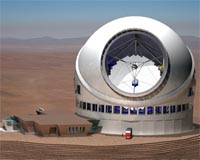
Rochester NY (SPX) Oct 22, 2008 The Gordon and Betty Moore Foundation recently awarded Rochester Institute of Technology $2.8 million to design, develop and build a zero-noise detector for the future Thirty Meter Telescope. Expected to be operational in the next decade, the telescope's light-collecting power will be 10 times that of the largest telescopes now in operation. The detector's new sensing technology promises to penetrate the darkness of space with the greatest sensitivity ever. It could also have applications on Earth to improve everything from cell phone cameras to secure communications and surveillance systems. RIT scientist Donald Figer will lead the project. Imaging sensors produce their own "noisy" signal that often degrades images, especially under low-light conditions. The noise can sometimes be seen as the grainy, salt-and-pepper speckling found in pictures snapped in a dark room. In applications like astrophysics, that noise can do more than ruin a picture; it can mean the difference between making a discovery or not. According to Figer, the zero-noise detector employed with the Thirty Meter Telescope will have the same sensitivity as a combination of today's detectors and a 60-meter telescope for probing the farthest reaches of the universe. "You could quadruple the power of a telescope just by using this detector," says Figer, director of the Rochester Imaging Detector Laboratory at RIT's Chester F. Carlson Center for Imaging Science. "Or you can do the same thing by making a telescope twice the size, but then we're talking a cost of billions of dollars and taking on a monumental engineering challenge." "Don's detector research represents a technological leap forward for astrophysics and for a variety of industrial and commercial applications, as well," says RIT President Bill Destler. "The Rochester Imaging Detector Laboratory was established at RIT with the help of the New York State Foundation for Science, Technology and Innovation. In just three years, it has gained stature as an epicenter for imaging innovation." Figer will lead a team of scientists from RIT and Massachusetts Institute of Technology's Lincoln Laboratory to create a detector unlike any available today. "This detector will have more Earthly applications too. For instance, you'll be able to see things in low-light conditions, especially from twilight down to the darkness of the darkest night," Figer says. "For some applications, it will be the difference between seeing nothing and seeing everything." The technological breakthrough promising to pierce the darkness of space hinges on resolving the pesky problem of noise. Noise limits all existing detectors-whether in a point-and-shoot camera, a video camera or a detector attached to a telescope. A product of the device itself, noise is present in the random signals detectors generate, but especially disruptive under low-light conditions. The random signal, also known as "detector read noise," muddles images shot in poor lighting. Designing a device using a digital photon counter to detect every single photon-or unit of light-coming from a target can circumvent the problem. To do this, Figer and his colleagues will adapt prototype technologies developed at Lincoln Laboratory that already have some of the basic circuitry required to detect a single quantum of light. These circuits are currently used for LIDAR (Light Detection and Ranging) applications that detect pulses of light or bunches of photons. "What we're trying to do is to detect single photons, each producing a much smaller pulse than the big packet of photons in the LIDAR applications," Figer says. "So, we're going to have to go back to the basic engineering and figure out the things that need to be modified in the design to make it more capable of detecting single photons." Figer will test the new detector at cryogenic temperatures in the Rochester Imaging Detector Laboratory. Cooling the device to lower temperatures will freeze its dark current, another potential source of noise, and keep it stuck in the crystal lattice like flies on flypaper and away from the conduction band. In the second phase of the project, Figer's team will adapt the detector technology to infrared applications, replacing silicon, a material sensitive only in optical light, with the semiconductor material Indium Gallium Arsenide (InGaAs). The infrared version of the detector will give astrophysicists the ability to peer through cosmic dust and also to detect stars in the early universe. "If you want to look back into the early universe, you have to look back into the infrared," Figer says. Community Email This Article Comment On This Article Share This Article With Planet Earth
Related Links Gordon and Betty Moore Foundation Space Telescope News and Technology at Skynightly.com
 STFC Tests Components For JWST
 London, UK (SPX) Oct 22, 2008
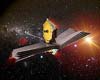
The STFC Space Science and Technology Department (SSTD) has been awarded a BP 800 thousand contract to carry out environmental testing on a cryogenic harness for the James Webb Space Telescope (JWST) - which will succeed the Hubble Space Telescope and explore the formation of the first stars and galaxies by looking at light from the early Universe. |
|
|

| The content herein, unless otherwise known to be public domain, are Copyright 1995-2007 - SpaceDaily.AFP and UPI Wire Stories are copyright Agence France-Presse and United Press International. ESA Portal Reports are copyright European Space Agency. All NASA sourced material is public domain. Additional copyrights may apply in whole or part to other bona fide parties. Advertising does not imply endorsement,agreement or approval of any opinions, statements or information provided by SpaceDaily on any Web page published or hosted by SpaceDaily. Privacy Statement |
 del.icio.us
 Digg
Digg Reddit
 YahooMyWeb
 Google
 Facebook