US urges Russia to consider missile offer: diplomat
The United States wants to boost cooperation with Russia on short- and medium-range missiles, a senior NATO diplomat said Monday, after Washington signalled a review of its missile shield plans. "The administration is making a renewed offer, to say we would like to work with Russia on missile defence and we hope that Russia is more willing to discuss that," the diplomat said, on condition of anonymity. He said Washington "genuinely wants to work with Russia on missile defence, believes that these threats, particularly the short- and medium-range ones, already exist." "We have a common interest with Russia in figuring out how to protect populations against these, we should be exploring how to do that," he said. The United States has been negotiating with Poland and the Czech Republic to install 10 missile interceptors, which would not carry explosive warheads, and a radar system on their territories. The move has angered Russia as it sees the system as a threat to its security, while Washington argues the proposed shield is only directed at "rogue states," primarily Iran. Russia had threatened to deploy Iskander missiles to Kaliningrad, a Russian enclave wedged between Poland and Lithuania, both NATO and EU members, if Washington did not halt its shield plans. Laying out a vision of new US foreign policy Saturday, Vice President Joe Biden sought to reach out to Moscow, in a speech described by Russian Deputy Prime Minister Sergei Ivanov as positive. Addressing the Munich Security Conference in Germany, Biden said the United States would only press ahead with its missile defence shield project "provided the technology is proven to work and cost effective." Nevertheless the NATO diplomat said President Barack Obama's administration was not shelving its plans, but that "it's rather being prudent about the management of an expensive programme." "They want to take the time to do a review, to look at the test results, to make a judgement about the level of technological development," he said. |
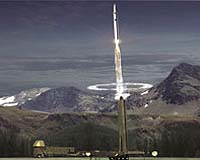
The Kinetic Energy Interceptor's mobility on the ground, in the air and at sea enables the system to get as close as possible to enemy launch sites, affording more options for achieving early interception of hostile missiles than any other surface-based missile defense system currently being developed.
These and other features make the Kinetic Energy Interceptor a highly versatile defensive system, able to intercept missiles of widely varying ranges and characteristics in three distinct phases of their trajectory.
The flexibility of the system is further enhanced by the capacity of each interceptor to host multiple kill vehicles that can home in on all the targets presented by a lofting missile in ascent phase, thereby reducing the challenge of discriminating warheads from boosters.
The latter capability is becoming more important as adversaries implement evasive tactics designed to foil the targeting systems of earlier missile defenses.
Despite the system's many promising features, the Missile Defense Agency has repeatedly restructured the Kinetic Energy Interceptor. Initially viewed as mainly a boost-phase interception system, it later was shifted to emphasis on midcourse interception as the ability of other systems to intercept warheads in space was called into question.
However, the ability to make such shifts underscores the intrinsic versatility of the system, a key reason for keeping it on track.
The first booster flight of the Kinetic Energy Interceptor is planned for 2009, and could prove to be a key factor in deciding whether the new Obama administration continues to fund the program.
The KEI was conceived as a fast-reacting missile that could intercept ballistic threats at multiple points in their trajectory. Once integrated into a defensive network, it will receive inputs from a wide array of sensors that enable the system to optimize interception opportunities.
The Airborne Laser is the most revolutionary component of the nation's ballistic missile defense system. The ABL program was begun in 1996 with the goal of integrating a megawatt-class laser on a commercial transport that could fly close to launch sites in enemy countries and destroy ballistic missiles while they were still in the boost phase of their trajectories.
Light travels at a constant speed of 186,000 miles per second, so substitution of a high-energy laser for interceptor missiles greatly improves the prospects of achieving interception during the three to five minutes when boosters are burning.
Doubts about the feasibility of boost-phase interception typically focus on the time required to reach a hostile missile once detection of a launch occurs, but ABL reduces that time to seconds.
The ABL weapons system is carried on a heavily modified Boeing 747-400 commercial transport. Other than the airframe itself, the weapon consists of three major subsystems.
(Part 10: How the Airborne Laser works)
(United Press International's "Outside View" commentaries are written by outside contributors who specialize in a variety of important issues. The views expressed do not necessarily reflect those of United Press International. In the interests of creating an open forum, original submissions are invited.)
 del.icio.us
 Digg
Digg Reddit
 YahooMyWeb
 Google
 Facebook

