|
 |
 |
 |
 |
 |
 |
 |
 |
 |

| . |  |
. |
NASA'S Pluto Space Probe Begins Launch Preparations
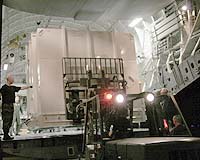
Cape Canaveral FL (SPX) Sep 27, 2005 NASA's New Horizons spacecraft arrived at the Kennedy Space Center, Florida on Saturday for final preparations and testing for the probe's decade-long journey. It will be the first spacecraft to visit Pluto and its moon Charon. New Horizons arrived at Kennedy's Shuttle Landing Facility aboard a U.S. Air Force C-17 cargo plane and was moved to a clean room for processing and testing. It is scheduled to launch on a Lockheed Martin Atlas V rocket in January 2006. New Horizons recently completed four months of space- environment tests at NASA's Goddard Space Flight Center, Greenbelt, Md., and the John Hopkins University Applied Physics Laboratory, Laurel, Md., where it was designed and built. Carrying seven scientific instruments the compact, nearly 1,000 pound probe will fly by Pluto and Charon as early as summer 2015. Its mission is to characterize the global geology and geomorphology of the bodies, map their surface compositions, record temperatures, and examine Pluto's complex atmosphere. Fly bys of ancient rocky objects farther out in the solar system may be undertaken during an extended mission. In October New Horizons will undergo a series of functional tests, readiness checks, and an "end-to-end" test with the tracking facilities of NASA's Deep Space Network. In November, hydrazine fuel for attitude control and course correction maneuvers will be loaded, and the spacecraft will undergo a final spin-balance test. At the Atlas Space Operations Center on Cape Canaveral Air Force Station, processing is underway on the Atlas V. Stacking of the vehicle at Launch Complex 41 begins in early October and will be completed late that month or in early November. A launch countdown rehearsal will be performed in November. In December, the flight-ready spacecraft will be transported to the launch pad for hoisting on to the Atlas V. Following final launch approval, liftoff is scheduled for Jan. 11, 2006, during a two-hour launch window that opens at 2:07 p.m. EST. Launch windows are also available daily from Jan. 12 through Feb. 14, 2006. New Horizons is the first mission in NASA's New Frontiers program of medium-class planetary missions. The Applied Physics Laboratory will operate the spacecraft for NASA's Science Mission Directorate. Principal investigator Alan Stern of the Southwest Research Institute, San Antonio, leads the New Horizons science and mission team. Southwest Research Institute directed the development of the mission's seven science instruments. The National Research Council ranked the first reconnaissance of Pluto and the Kuiper Belt at the top of its priority list for planetary missions this decade. A close-up look at these mysterious bodies will provide new information about the origin and evolution of our solar system. Related Links NASA's New Horizons mission SpaceDaily Search SpaceDaily Subscribe To SpaceDaily Express  Santa et al
 Moffett Field CA (SPX) Sep 13, 2005
Since 1949 the 48-inch (1.2 m) Samuel Oschin Telescope has been quietly working to improve our understanding of the universe. It nightly scans the skies, returning discoveries that astound and amaze. |
|
|

| The content herein, unless otherwise known to be public domain, are Copyright 1995-2006 - SpaceDaily.AFP and UPI Wire Stories are copyright Agence France-Presse and United Press International. ESA PortalReports are copyright European Space Agency. All NASA sourced material is public domain. Additionalcopyrights may apply in whole or part to other bona fide parties. Advertising does not imply endorsement,agreement or approval of any opinions, statements or information provided by SpaceDaily on any Web page published or hosted by SpaceDaily. Privacy Statement |