The importance of understanding dark energy also has been emphasized in a number of other significant reports from the National Research Council, the National Science and Technology Council, and the Dark Energy Task Force.
The importance of understanding dark energy also has been emphasized in a number of other significant reports from the National Research Council, the National Science and Technology Council, and the Dark Energy Task Force. |
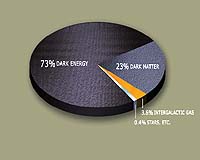
Dark energy is a form of energy that pervades and dominates the universe. The mission will measure with high precision the universe's expansion rate and growth structure. Data from the mission could help scientists determine the properties of dark energy, fundamentally advancing physics and astronomy.
"Understanding the nature of dark energy is the biggest challenge in physics and astronomy today," said Jon Morse, director of astrophysics at NASA Headquarters in Washington. "JDEM will be a unique and major contributor in our quest to understand dark energy and how it has shaped the universe in which we live."
One of the most significant scientific findings in the last decade is that the expansion of the universe is accelerating. The acceleration is caused by a previously unknown dark energy that makes up approximately 70 percent of the total mass energy content of the universe.
This mission has the potential to clarify the properties of this mass energy. JDEM also will provide scientists with detailed information for understanding how galaxies form and acquire their mass.
"DOE and NASA have complementary on-going research into the nature of dark energy and complementary capabilities to build JDEM, so it is wonderful that our agencies have teamed for the implementation of this mission," said Dennis Kovar, associate director of the DOE Office of Science for High Energy Physics.
In 2006, NASA and DOE jointly funded a National Research Council study by the Beyond Einstein Program Assessment Committee to assist NASA in determining the highest priority of the five proposed missions in its Beyond Einstein program.
In September 2007, the committee released its report and noted that JDEM will set the standard in precisely determining the distribution of dark energy in the distant universe. The committee recommended that JDEM be the first of NASA's Beyond Einstein missions to be developed and launched. Following the committee's report, NASA and DOE agreed to proceed with JDEM.
The importance of understanding dark energy also has been emphasized in a number of other significant reports from the National Research Council, the National Science and Technology Council, and the Dark Energy Task Force.
Share This Article With Planet Earth
 del.icio.us del.icio.us |
 Digg Digg |
 Reddit Reddit |
 YahooMyWeb YahooMyWeb |
 Google Google |
 Facebook Facebook |
 Giant Simulation Could Solve Mystery Of Dark Matter
 Durham, UK (SPX) Nov 06, 2008
| The content herein, unless otherwise known to be public domain, are Copyright 1995-2007 - SpaceDaily.AFP and UPI Wire Stories are copyright Agence France-Presse and United Press International. ESA Portal Reports are copyright European Space Agency. All NASA sourced material is public domain. Additional copyrights may apply in whole or part to other bona fide parties. Advertising does not imply endorsement,agreement or approval of any opinions, statements or information provided by SpaceDaily on any Web page published or hosted by SpaceDaily. Privacy Statement |