|
 |
 |
 |
 |
 |
 |
 |
 |
 |

| . |  |
. |
NASA Budget Shuts Out Icy Moons Mission
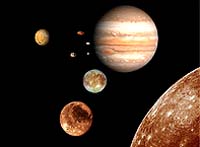
Washington DC (SPX) Feb 08, 2006 NASA's budget document for fiscal year 2007 contains 451 pages and nearly 150,000 words, but nowhere in that sea of text is one word mentioned that represents great importance to certain members of the scientific and astronomical communities: Europa. In its attempts to live within its current budget parameters, which call for NASA to expand funding for its human spaceflight effort to return to the Moon and mount missions to Mars and beyond in the future, and to trim funding for space shuttle flights and end them altogether by 2010, the agency has had to postpone or eliminate several projects deemed important by various sectors. One such project is a robotic mission to the icy moons of Jupiter - also known as the Galilean moons, because they were discovered by Italian astronomer Galileo Galilei in 1610. Scientists have held a particular interest in Europa, an icy ball about the size of the Moon and thought to contain a subsurface sea of liquid water, thereby making it another prime candidate for harboring alien life. For the past several years, NASA had been planning a mission to Europa and the two other icy Jovian satellites: Callisto and Ganymede - but leaving out arid and volcanically active Io. Agency engineers were in the process of designing a nuclear-powered spacecraft originally called JIMO, for Jupiter Icy Moons Orbiter, but that project eventually was scrapped, and superseded by a new, leaner probe called Prometheus. Whatever the probe, the planned mission to the icy moons was supposed to complement the Cassini spacecraft's four-year-plus mission to the Saturnian system, which thus far has proved spectacularly successful. Now, NASA also has brought the Jovian project to a halt. "This year significant restructuring of the Agency's priorities have (made it) necessary to close-out former (Prometheus) activities and initiate a modest nuclear systems and technology research program focused on meeting future high power and propulsion needs for exploration," the agency said in its budget document. NASA made this decision despite endorsements for a mission to Europa by both the National Academy of Sciences and the agency's own advisory committee on planetary exploration missions, as well as Congress effectively ordering NASA in 2005 to send a spacecraft as soon as possible to the moon. "If the proposed budget is adopted, that directive will be ignored, and no Europa mission will be planned," Louis Friedman, executive director of the Planetary Society, said in a statement. "NASA's robotic exploration program is being flat-lined, setting aside a mission to Europa to search for its ice-covered ocean and perhaps for life itself." Part of the reason for the mission's abandonment is NASA's tactical decision not to mount a major effort to develop nuclear propulsion systems at this time. At his briefing on the budget Monday, NASA administrator Michael Griffin told reporters his agency had decided to rely on other nations for leadership in space nuclear propulsion - something deemed necessary for a long-term mission to the Jovian system. At present, Russia is the acknowledged leader in nuclear propulsion, although "France (also) generates a significant amount of its internal energy with nuclear power, and Japan is making interesting inroads in the development of small nuclear reactors," Griffin said. "It isn't necessarily just the space part of that technology that's necessarily relevant to us. One eventually needs to combine space technology with nuclear reactor technology to yield a useful product, and we would be interested as part of our overall vision for space exploration to work with any nation that would share similar goals and might be able to bring that part of the puzzle to the table." Whether such a policy will help renew the prospect of a mission to Jupiter's moons in the near future remains uncertain. Related Links NASA  Jupiter's Massive Winds Likely Generated From Deep Inside Its Interior
 Los Angeles CA (SPX) Nov 14, 2005
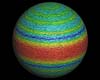
A new computer model indicates Jupiter's massive winds are generated from deep within the giant planet's interior, a UCLA scientist and international colleagues report last Thursday in the journal Nature. |
|
|

| The content herein, unless otherwise known to be public domain, are Copyright 1995-2006 - SpaceDaily.AFP and UPI Wire Stories are copyright Agence France-Presse and United Press International. ESA PortalReports are copyright European Space Agency. All NASA sourced material is public domain. Additionalcopyrights may apply in whole or part to other bona fide parties. Advertising does not imply endorsement,agreement or approval of any opinions, statements or information provided by SpaceDaily on any Web page published or hosted by SpaceDaily. Privacy Statement |