
 |
 |
 |
 |
 |
 |
 |
 |
 |
 |

| . |  |
. |

Pasadena CA (JPL) Jan 28, 2011 NASA's Stardust spacecraft has downlinked its first images of comet Tempel 1, the target of a flyby planned for Valentine's Day, Feb. 14. The images were taken on Jan. 18 and 19 from a distance of 26.3 million kilometers (16.3 million miles), and 25.4 million kilometers (15.8 million miles) respectively. On Feb. 14, Stardust will fly within about 200 kilometers (124 miles) of the comet's nucleus. "This is the first of many images to come of comet Tempel 1," said Joe Veverka, principal investigator of NASA's Stardust-NExT mission from Cornell University, Ithaca, N.Y. "Encountering something as small and fast as a comet in the vastness of space is always a challenge, but we are very pleased with how things are setting up for our Valentine's Day flyby." The composite image is a combination of several images taken by Stardust's navigation camera. Future images will be used to help mission navigators refine Stardust's trajectory, or flight path, as it closes the distance between comet and spacecraft at a rate of about 950,000 kilometers (590,000 miles) a day. On the night of encounter, the navigation camera will be used to acquire 72 high-resolution images of the comet's surface features. Stardust-NExT mission scientists will use these images to see how surface features on comet Tempel 1 have changed over the past five-and-a-half years. (Tempel 1 had previously been visited and imaged in July of 2005 by NASA's Deep Impact mission). Launched on Feb. 7, 1999, Stardust became the first spacecraft in history to collect samples from a comet (comet Wild 2), and return them to Earth for study. While its sample return capsule parachuted to Earth in January 2006, mission controllers were placing the still-viable spacecraft on a path that would allow NASA the opportunity to re-use the already-proven flight system if a target of opportunity presented itself. In January 2007, NASA re-christened the mission "Stardust-NExT" (New Exploration of Tempel), and the Stardust team began a four-and-a-half year journey for the spacecraft to comet Tempel 1. This will be the second exploration of Tempel 1 by a spacecraft (Deep Impact). Along with the high-resolution images of the comet's surface, Stardust-NExT will also measure the composition, size distribution and flux of dust emitted into the coma, and provide important new information on how Jupiter-family comets evolve and how they formed 4.6 billion years ago.
Share This Article With Planet Earth
Related Links Stardust-NExT Asteroid and Comet Mission News, Science and Technology

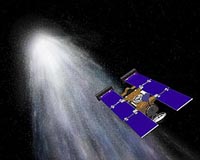 NASA Spacecraft Prepares For Valentine's Day Comet Rendezvous
Pasadena CA (SPX) Jan 20, 2011 NASA's Stardust-NExT spacecraft is nearing a celestial date with comet Tempel 1 at approximately 8:37 p.m. PST (11:37 p.m. EST), on Feb. 14. The mission will allow scientists for the first time to look for changes on a comet's surface that occurred following an orbit around the sun. The Stardust-NExT, or New Exploration of Tempel, spacecraft will take high-resolution images during the enco ... read more |
|
|
| The content herein, unless otherwise known to be public domain, are Copyright 1995-2010 - SpaceDaily. AFP and UPI Wire Stories are copyright Agence France-Presse and United Press International. ESA Portal Reports are copyright European Space Agency. All NASA sourced material is public domain. Additional copyrights may apply in whole or part to other bona fide parties. Advertising does not imply endorsement,agreement or approval of any opinions, statements or information provided by SpaceDaily on any Web page published or hosted by SpaceDaily. Privacy Statement |


 del.icio.us
 Digg
Digg Reddit
 YahooMyWeb
 Google
 Facebook


