|
 |
 |
 |
 |
 |
 |
 |
 |
 |

| . |  |
. |
NASA Concludes Successful FUSE Mission
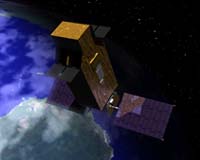
Greenbelt MD (SPX) Oct 19, 2007 After an eight-year run that gave astronomers a completely new perspective on the universe, NASA has concluded the Far Ultraviolet Spectroscopic Explorer mission. The satellite, known as FUSE, became inoperable in July when the satellite lost its ability to point accurately and steadily at areas of interest. NASA will terminate the mission Oct. 18. "FUSE accomplished all of its mission goals and more," said Alan Stern, associate administrator for the Science Mission Directorate at NASA Headquarters, Washington. "FUSE vastly increased our understanding of our galaxy's evolution and many exotic phenomena and left a strong legacy on which to build the next generation of investigations and missions." Launched in 1999, FUSE helped scientists answer important questions about the conditions in the universe immediately following the Big Bang, how chemicals disperse throughout galaxies, and the composition of interstellar gas clouds that form stars and solar systems. "FUSE helped pioneer low-cost, principal investigator-led astronomy missions," said Jon Morse, director of the Astrophysics Division at NASA Headquarters. Examples of the many successes FUSE achieved during its mission: By measuring abundances of molecular hydrogen (made of two hydrogen atoms), FUSE showed that a large amount of water has escaped from Mars, enough to form a global ocean 100 feet deep. FUSE observed a debris disk that is surprisingly rich in carbon gas orbiting the young star Beta Pictoris. The carbon overabundance indicates either the star is forming planets that could end up as exotic, carbon-rich worlds of graphite and methane, or Beta Pictoris is revealing an unsuspected phenomenon that also occurred in the early solar system. FUSE discovered far more deuterium, a form of hydrogen with a proton and a neutron instead of just one proton, in the Milky Way galaxy than astronomers had expected. Deuterium was produced in the early universe, but this isotope is destroyed easily in stellar nuclear reactions. "FUSE showed that less deuterium has been burned in stars over cosmic time, in agreement with modern models for the evolution of the galaxy and the recent Wilkinson Microwave Anisotropy Probe results," said Warren Moos, FUSE principal investigator, Johns Hopkins University, Baltimore. FUSE saw that an atmosphere of very hot gas surrounds the Milky Way. The ubiquity of hot gas around our galaxy demonstrates the galaxy is even more dynamic than expected. By detecting highly ionized oxygen atoms in intergalactic space, FUSE showed that about 10 percent of matter in the local universe consists of million-degree gas floating between the galaxies. This discovery might help resolve the long-standing mystery of the universe's "missing baryons." Baryons are subatomic particles, often protons and neutrons. Calculations of how many baryons were produced in the very early universe predict about twice as many baryons as astronomers have observed. The rest of the missing baryons might exist as even hotter gas, which could be observed by future X-ray observatories such as NASA's Constellation-X. "FUSE collected quality science data for eight years, longer than its five-year goal. By any measure, FUSE was a success," said George Sonneborn, FUSE project scientist at NASA's Goddard Space Flight Center, Greenbelt, Md. Although FUSE's mission has ended, NASA's ultraviolet study of the universe continues. In 2008, NASA will conduct a servicing mission to the Hubble Space Telescope to install a new ultraviolet spectrograph on the telescope and repair another. The new Cosmic Origins Spectrograph, or COS, is designed to study remote galaxies and nearby stars in the ultraviolet. Hubble's Space Telescope Imaging Spectrograph also will be repaired. That instrument had ultraviolet capabilities complementary to the COS and was used in conjunction with FUSE when both were operational. The spectrograph failed due to an electronic short in August 2004 after more than seven years of in-orbit operations. FUSE was a joint mission of NASA, the Canadian Space Agency and the French Space Agency, the Centre National d'Etudes Spatiales. The Johns Hopkins University built the telescope and managed the mission. The University of Colorado, Boulder, built FUSE's spectrograph. The University of California, Berkeley, made the detectors. Community Email This Article Comment On This Article Related Links FUSE Space Telescope News and Technology at Skynightly.com
 FUSE Reaches The End As Astronomers Say Farewell
 Baltimore MD (SPX) Oct 16, 2007
The intrepid never-say-die space telescope known as FUSE has finally reached its mission's end and will be turned off after more than eight years of discoveries on everything from planets and nearby stars to galaxies and quasars billions of light-years away. The satellite's control room on the Johns Hopkins Homewood campus will go dark on Oct. 18, leaving the satellite itself - its pointing system so often pulled from the brink of inoperability by enterprising engineers and scientists in that control room - to continue circling the Earth. Eventually, decades from now, its orbit will decay and the satellite will burn up in the atmosphere. |
|
|

| The content herein, unless otherwise known to be public domain, are Copyright 1995-2006 - SpaceDaily.AFP and UPI Wire Stories are copyright Agence France-Presse and United Press International. ESA PortalReports are copyright European Space Agency. All NASA sourced material is public domain. Additionalcopyrights may apply in whole or part to other bona fide parties. Advertising does not imply endorsement,agreement or approval of any opinions, statements or information provided by SpaceDaily on any Web page published or hosted by SpaceDaily. Privacy Statement |