|
 |
 |
 |
 |
 |
 |
 |
 |
 |

| . |  |
. |
NASA Conducts Census Of Nearby Hidden Black Holes
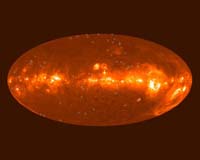
Greenbelt MD (SPX) Aug 02, 2006 NASA scientists on a quest to find hidden black holes in the local universe have found surprisingly few, the agency announced Wednesday. The observation implies that if these hidden black holes exist - and most scientists are convinced they do - they must be from the more distant, earlier universe, a concept that has interesting implications for galaxy evolution. The work constitutes the first census of the highest-energy part of the X-ray sky, where the most dust-enshrouded black holes are thought to shine. A team from NASA's Goddard Space Flight Center conducted the census, comprising nearly two years of continuous data from the ESA' International Gamma Ray Astrophysics Laboratory, or INTEGRAL, satellite. "Naturally it is difficult to find something we know is hiding well and which has eluded detection so far," said Volker Beckmann of Goddard and the University of Maryland, Baltimore County, lead author on a report in an upcoming issue of The Astrophysical Journal. "INTEGRAL is a telescope that should see nearby hidden black holes, but we have come up short," Beckmann added. The X-ray sky is thousands to millions of times more energetic than the visible sky. Much of the X-ray activity is from black holes violently sucking in gas from their surroundings. Recent breakthroughs in X-ray astronomy, including a thorough black hole census with NASA's Chandra X-ray Observatory and Rossi X-ray Timing Explorer, have all dealt with lower-energy X-rays. The energy range is roughly 2,000 to 20,000 electron-volts. Optical light, in comparison, is about 2 electron volts. The INTEGRAL survey is the first of its kind to glimpse into the largely unexplored higher-energy, or hard, X-ray regime of 20,000 to 40,000 electron-volts. "The X-ray background, this pervasive blanket of X-ray light we see everywhere in the universe, peaks at about 30,000 electron volts, yet we really know next to nothing about what produces this radiation," said co-author Neil Gehrels of Goddard. The hypothesis is hidden black holes, which scientists call Compton-thick objects, are responsible for the peak at 30,000 electron volts. These X-rays are so energetic that they would penetrate even the most dust-enshrouded black holes yet remain beyond the range of powerful lower-energy X-ray observatories such as Chandra. High-energy light in general is harder to focus than optical and lower-energy (longer-wavelength) forms of light. As a result, INTEGRAL doesn't have the resolution to make sharp images like Chandra and Hubble can. "Basically, the higher you go in energy, the harder it is to detect faint sources," said Chris Shrader of Goddard, another co-author. "This is why no hard X-ray mission has been able to study many individual objects in the distant universe. That would require a next-generation telescope. But INTEGRAL is now the first to resolve the local universe." INTEGRAL can obtain an unbiased count of black holes in the local universe by virtue of seeing even those that are hidden. Of all the black hole galaxies that INTEGRAL detected - that is, galaxies with supermassive black holes in their cores actively accreting gas - about 40 percent were unobscured black hole galaxies, called Seyfert 1 galaxies. About 50 percent were somewhat obscured black hole galaxies called Seyfert 2 galaxies. And less than 10 percent were the heavily shrouded "Compton thick" variety. This implies if hidden black holes make up the bulk of the X-ray background, they aren't local. Why? One reason could be that, in the modern local universe, these black holes have had time to blow away the gas and dust that once enshrouded them, leaving them unobscured. This liberation of gas and dust would have its consequences; it would blow away to influence star and galaxy formation elsewhere. "This is just the tip of the iceberg," Beckmann said. "In a few more months we will have a larger survey completed with the Swift mission. Our goal is to push this kind of observation deeper and deeper into the universe to see black hole activity at early epochs. That's the next great challenge for X-ray and gamma-ray astronomers." Simona Soldi and Nicolas Produit of the INTEGRAL Science Data Centre near Geneva, Switzerland, also participated in this result. Related Links INTEGRAL Stellar Chemistry, The Universe And All Within It  British Physics Labs To Merge
 Swindon, England (SPX) Jul 28, 2006
The Department of Trade and Industry announced Tuesday that the U.K. government has decided to create a new Large Facilities Council merging the Council for the Central Laboratory of the Research Councils and the Particle Physics and Astronomy Research Council following the Next Steps consultation exercise. |
|
|

| The content herein, unless otherwise known to be public domain, are Copyright 1995-2006 - SpaceDaily.AFP and UPI Wire Stories are copyright Agence France-Presse and United Press International. ESA PortalReports are copyright European Space Agency. All NASA sourced material is public domain. Additionalcopyrights may apply in whole or part to other bona fide parties. Advertising does not imply endorsement,agreement or approval of any opinions, statements or information provided by SpaceDaily on any Web page published or hosted by SpaceDaily. Privacy Statement |