|
 |
 |
 |
 |
 |
 |
 |
 |
 |

| . |  |
. |
NASA's James Webb Space Telescope Gets Spacewired
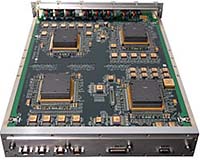
Greenbelt MD (SPX) Oct 26, 2007 NASA's James Webb Space Telescope will use a new advanced technology network interface called "SpaceWire" that enables the components on the telescope to work more efficiently and more reliably with each other. SpaceWire is a standard for high-speed communication links between satellite components. Originally developed by the European Space Agency, SpaceWire has been adopted and improved by a team at the NASA Goddard Space Flight Center in Greenbelt, Md. The James Webb Space Telescope (JWST) Integrated Science Instrument Module (ISIM) and Command and Data Handling (ICDH) engineering team has developed a small and very low power microchip that sends and receives SpaceWire signals at speeds of over 200 mega-bits per second. The new higher bandwidth from SpaceWire enables the JWST ISIM to support the mission's science instruments which employ 66 million detector pixels. This is the largest number of pixels ever used on a space telescope, and it will allow JWST to study more of the universe. Handling the large volume of data from these detectors presented a unique challenge for the JWST ICDH team. The development of this new network interface enables the JWST science instruments to realize their full scientific discovery potential, and will permit future NASA mission planners to consider use of more detectors with an even larger number of pixels to see even more of the universe. "Infusing the SpaceWire-based network interface into the JWST mission enables scientific discovery by allowing the JWST science instruments to operate at very high data collection rates," said Pam Sullivan, Manager of the JWST ISIM. SpaceWire is a standard for high-speed links and networks for use onboard a spacecraft, easing the interconnection of sensors, mass-memories and processing units. The SpaceWire standard provides many benefits. It helps facilitate the construction of high-performance onboard data handling systems, reduces system integration costs, increases compatibility between data handling equipment and subsystems, and encourages re-use of data handling equipment across several different missions. To understand the benefit of SpaceWire, you can compare the speed of a dial-up modem to a high-speed broadband Internet connection. SpaceWire connects multiple spacecraft components on super-fast links to get a quicker result. Goddard's version of the SpaceWire technology has also dramatically accelerated the development of the JWST instrument electronics. The JWST ICDH team delivered the SpaceWire technology - which is packaged in a digital, low power (1.5W), high speed (66Mbps) Field-Programmable Gate Array (FPGA) computer chip - to JWST partners including prime contractor Northrop Grumman, Lockheed, Jet Propulsion Laboratory (JPL), and the Canadian Space Agency. As a result of this JWST technology development, other missions are considering SpaceWire include the Lunar Reconnaissance Orbiter and the Geostationary Operational Environmental Satellite-R (GOES-R). SpaceWire is also being used for technology development at other NASA centers including the NASA Glenn Research Center, Cleveland, Ohio; JPL, Pasadena, Calif.; Langley Research Center, Hampton, Va. and the Marshall Space Flight Center, Huntsville, Ala. The benefit to other missions from using SpaceWire is a lower cost for development, a reduction of development time, better reliability, and an increase in the amount of scientific work that can be achieved within a limited budget. Commercially, nearly every major aerospace company in the U.S. has been provided with Goddard's technology either for projects with NASA or other government labs or for evaluation via a 90-day license. Now Goddard's technology is being distributed free via Software Usage Agreements. The James Webb Space Telescope is a 21st century space observatory that will peer back more than 13 billion years in time to understand the formation of galaxies, stars and planets and the evolution of our own solar system. It is expected to launch in 2013. The telescope is a joint project of NASA, the European Space Agency and the Canadian Space Agency. Community Email This Article Comment On This Article Related Links SpaceWire site James Webb Space Telescope site Space Telescope News and Technology at Skynightly.com
 Successful Planck RF Telescope Test At 320 GHz
 Cannes, France (SPX) Oct 25, 2007
This article reports on the recently concluded Planck Radio Frequency Qualification Model (RFQM) test campaign in the Thales Alenia Space Compact Antenna Test Range (CATR) facility, Cannes, France. The campaign gave to engineers and scientists confirmation that the planned RF verification method of the alignment of the Flight Model (FM) telescope is completely operational and can be performed with confidence on the FM spacecraft early next year. |
|
|

| The content herein, unless otherwise known to be public domain, are Copyright 1995-2006 - SpaceDaily.AFP and UPI Wire Stories are copyright Agence France-Presse and United Press International. ESA PortalReports are copyright European Space Agency. All NASA sourced material is public domain. Additionalcopyrights may apply in whole or part to other bona fide parties. Advertising does not imply endorsement,agreement or approval of any opinions, statements or information provided by SpaceDaily on any Web page published or hosted by SpaceDaily. Privacy Statement |