|
 |
 |
 |
 |
 |
 |
 |
 |
 |

| . |  |
. |
NASA Mishap Board Identifies Cause Of X-43A Failure
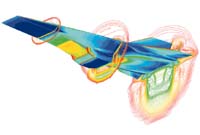
Edwards - Jul 24, 2003 The NASA mishap investigation board, charged to review the loss of the X-43A Hyper-X program research vehicle during its June 2, 2001 launch, concluded no single factor or potential contributing factor caused the mishap. The flight failed because the vehicle's control system design was deficient in several analytical modeling areas, which overestimated the system's margins. NASA's Hyper-X program is developing "air breathing" engine technologies that promise performance benefits for future hypersonic aircraft and reusable space launch vehicles. In the X-43A test program, three, 12-foot long, unpiloted vehicles were planned to fly up to 10 times the speed of sound to demonstrate scramjet, or supersonic-combustion ramjet, technologies. The mishap occurred on the first of three planned flights. For the launch, the X-43A was attached to the nose of a modified Pegasus launch vehicle, which was carried by NASA's modified B-52 bomber. Seventy-five minutes after takeoff, at an altitude of approximately 24,000 ft., the Pegasus was released. Its solid rocket motor ignited 5.2 seconds later sending the launch vehicle and research vehicle payload on its test flight. Eight seconds later, the vehicle began its planned pitch up maneuver, which was expected to take it to an altitude of approximately 95,000 ft. Shortly thereafter, the X-43A began to experience a control anomaly characterized by a roll oscillation. At 13.5 seconds after release and at an altitude of approximately 22,000 ft., structural overload of the starboard elevon occurred. The severe loss of control caused the X-43A to deviate significantly from its planned trajectory, and as a result, it was destroyed by range safety 48.6 seconds after release. The mishap board found the major contributors to the mishap were modeling inaccuracies in the fin actuation system, modeling inaccuracies in the aerodynamics, and insufficient variations of modeling parameters. The flight mishap could only be reproduced when all of the modeling inaccuracies with uncertainty variations were incorporated in the analysis. "I want to thank the Mishap Investigation Board for their comprehensive and thorough evaluation," said Dr. Victor Lebacqz, acting Associate Administrator for NASA's Office of Aerospace Technology. "The findings and recommendations of the board greatly enhance our opportunity for a successful second flight," he said. Nine chapters of the 11-chapter mishap investigation report are available to the public. Chapters nine and 10, and supporting data, are being withheld to comply with U.S. export control regulations, protection of industry proprietary information, or for pre-decisional reasons. The releasable chapters are available on the Internet at: Related lessons learned from the X-43A mishap investigation will also be added to the NASA lessons learned information system, which is available on the Internet Related Links Report in Depth SpaceDaily Search SpaceDaily Subscribe To SpaceDaily Express  Marshall Rocket Scientists Recreates First Liquid-Fueled Rocket
 Huntsville - Jul 24, 2003
A team of engineers from NASA's Marshall Space Flight Center in Huntsville, Ala., is hard at work on a project to "recreate history" by building a pair of replicas of the world's first liquid-fueled rocket. One of them is a working version that is undergoing ground tests at the Marshall Center this summer. |
|
|

| The content herein, unless otherwise known to be public domain, are Copyright 1995-2006 - SpaceDaily.AFP and UPI Wire Stories are copyright Agence France-Presse and United Press International. ESA PortalReports are copyright European Space Agency. All NASA sourced material is public domain. Additionalcopyrights may apply in whole or part to other bona fide parties. Advertising does not imply endorsement,agreement or approval of any opinions, statements or information provided by SpaceDaily on any Web page published or hosted by SpaceDaily. Privacy Statement |