|
 |
 |
 |
 |
 |
 |
 |

| . |  |
. |

|
|
. |

 by Staff Writers Pasadena CA (JPL) Oct 07, 2011
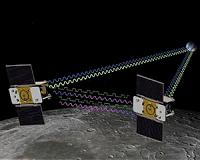
NASA's Gravity Recovery And Interior Laboratory (GRAIL)-B spacecraft successfully executed its first flight path correction maneuver Wednesday, Oct. 5. The rocket burn helped refine the spacecraft's trajectory as it travels from Earth to the moon and provides separation between itself and its mirror twin, GRAIL-A. The first burn for GRAIL-A occurred on Sept. 30. "Both spacecraft are alive and with these burns, prove that they're kicking too, as expected," said David Lehman, GRAIL project manager at NASA's Jet Propulsion Laboratory in Pasadena, Calif. "There is a lot of time and space between now and lunar orbit insertion, but everything is looking good." GRAIL-B's rocket burn took place on Oct. 5 at 11 a.m. PDT (2 p.m. EDT). The spacecraft's main engine burned for 234 seconds and imparted a velocity change of 56.1 mph (25.1 meters per second) while expending 8.2 pounds (3.7 kilograms) of propellant. GRAIL-A's burn on Sept. 30 also took place at 11 a.m. PDT. It lasted 127 seconds and imparted a 31.3 mph (14 meters per second) velocity change on the spacecraft while expending 4 pounds (1.87 kilograms) of propellant. These burns are designed to begin distancing GRAIL-A and GRAIL-B's arrival times at the moon by approximately one day and to insert them onto the desired lunar approach paths. The straight-line distance from Earth to the moon is about 250,000 miles (402,336 kilometers). It took NASA's Apollo moon crews about three days to cover that distance. Each of the GRAIL twins is taking about 30 times that long and covering more than 2.5 million miles (4 million kilometers) to get there. This low-energy, high-cruise time trajectory is beneficial for mission planners and controllers, as it allows more time for spacecraft checkout. The path also provides a vital component of the spacecraft's single science instrument, the Ultra Stable Oscillator, to be continuously powered for several months, allowing it to reach a stable operating temperature long before beginning the collection of science measurements in lunar orbit. GRAIL-A will enter lunar orbit on New Year's Eve, and GRAIL-B will follow the next day. When science collection begins, the spacecraft will transmit radio signals precisely defining the distance between them as they orbit the moon. Regional gravitational differences on the moon are expected to expand and contract that distance. GRAIL scientists will use these accurate measurements to define the moon's gravity field. The data will allow mission scientists to understand what goes on below the surface of our natural satellite.
GRAIL at NASA Mars News and Information at MarsDaily.com Lunar Dreams and more
|
. |
|
| The content herein, unless otherwise known to be public domain, are Copyright 1995-2011 - Space Media Network. AFP and UPI Wire Stories are copyright Agence France-Presse and United Press International. ESA Portal Reports are copyright European Space Agency. All NASA sourced material is public domain. Additional copyrights may apply in whole or part to other bona fide parties. Advertising does not imply endorsement,agreement or approval of any opinions, statements or information provided by Space Media Network on any Web page published or hosted by Space Media Network. Privacy Statement |


 del.icio.us
 Digg
Digg Reddit
 Google