|
 |
 |
 |
 |
 |
 |
 |

| . |  |
. |

|
|
. |

 by Dauna Coulter for NASA Science News Huntsville AL (SPX) Aug 17, 2011
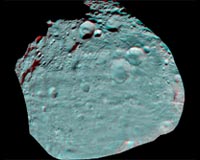
In a few years a NASA spacecraft will seek the building blocks of life in a shovelful of asteroid dirt. The OSIRIS-REx1 spacecraft, targeted for launch in September 2016, will intercept asteroid 1999 RQ36, orbit it for a year, and then reach out a robotic arm to touch its surface. "We call it 'touch and go,'" explains principal investigator Michael Drake of the University of Arizona. "OSIRIS-REx will approach the surface at 0.1 m/sec (only 0.2 mph, less than a tenth of walking pace) and, without landing, stretch out its arm equipped with a sample collector. We'll simply agitate the asteroid's surface with ultra-pure nitrogen to stir up material for capture." Asteroids appear to be as lifeless as Yorick's skull, yet material captured from 1999 RQ36 could hold clues to life's origin on Earth. Some scientists believe Earth's surface was sterilized2 soon after the planet was formed some 4.5 billion years ago. Planetoids and other debris left over from the genesis of planets pummeled Earth, turning it into a cratered wasteland. The tremendous kinetic energy from the collisions heated Earth to the boiling point. "Earth at 'time zero' had a steam atmosphere that was wrung out to make a boiling hot ocean," says Drake. "Imagine standing on a lava lake in Hawaii, but it's a planet-wide, 600 mile deep lake. You and everything else, including any organics and any one-celled organisms, would be converted to carbon dioxide and water. Gone." In this scenario, an infusion of organics from elsewhere might be required to ignite life here. The building blocks for life on our planet may have come, at least in part, from asteroids. "Observations by ground-based telescopes suggest that asteroid 1999 RQ36 has a wealth of carbon-based compounds, but we don't know exactly what is there. Are there amino acids? To find out, we need to bring a sample home where we have sophisticated, exquisitely precise instruments, plus the ability to react to new discoveries." Obtaining that sample is a key part of OSIRIS-REx's mission. Upon reaching 1999 RQ36 in 2019, the spacecraft's suite of cameras and instruments will spend a year photographing the asteroid and measuring its surface topography, composition, and thermal emissions while its radio provides mass and gravity field maps. This information will increase our understanding of asteroids as well as help the mission team select the most promising sample site. Like the ancient Egyptian god Osiris, the OSIRIS-REx mission is associated with death as well as life, with both our destiny and our origin. That's because 1999 RQ36 is the Near Earth Object "Most Likely to Succeed" - in affecting our destiny, that is. It has a 1/1800 chance of hitting Earth by the 22nd century. Evidence suggests that a 6-mile wide asteroid smashed into Earth about 65 million years ago, wiping out the dinosaurs and altering the history of life. Instead of dinosaurs prevailing, mammals flourished, evolving into humans. "We're the first species that can mitigate asteroid extinction," notes Drake. "With enough information, we can project the orbit of a threatening asteroid." If researchers can track an NEO's precise path, they can devise a way to nudge the object out of a collision course with Earth. OSIRIS-REx wil help NASA learn to navigate near an asteroid, laying the groundwork for landing on one. That could be pretty tricky, considering asteroids like 1999 RQ36 have so little gravity. "If you simply pushed your finger into the surface, you'd fly off into space, disappear, and never come back!" OSIRIS-REx, however, will hang close, and its cameras will give us window seats to watch its delicate sampling maneuvers. The mission team plans near-live coverage of the operations. But the real action starts, says Drake, when the sample is returned to Earth in 2023. A future story from Science@NASA will explain how the sample will be handled upon return and lay out some of the experiments researchers will do with it. Stay tuned.
|
. |
|
| The content herein, unless otherwise known to be public domain, are Copyright 1995-2011 - Space Media Network. AFP and UPI Wire Stories are copyright Agence France-Presse and United Press International. ESA Portal Reports are copyright European Space Agency. All NASA sourced material is public domain. Additional copyrights may apply in whole or part to other bona fide parties. Advertising does not imply endorsement,agreement or approval of any opinions, statements or information provided by Space Media Network on any Web page published or hosted by Space Media Network. Privacy Statement |

 del.icio.us
 Digg
Digg Reddit
 Google