|
 |
 |
 |
 |
 |
 |
 |

| . |  |
. |

|
|
. |

 by Staff Writers Moffett Field, CA (SPX) Jun 21, 2011
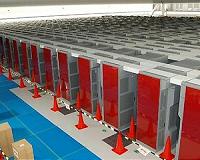
NASA's largest supercomputer is seventh on the TOP500 list of the world's most powerful, high-performance computers. The announcement was made at the 26th International Supercomputing Conference in Hamburg, Germany. Pleiades, located at NASA's Ames Research Center in Moffett Field, Calif., supports more than 1,000 active users around the country who are advancing our knowledge about the Earth, solar system and the universe. Pleiades is used to meet the computing needs on NASA's most demanding modeling and simulation projects in aeronautics; Earth and space science; exploration systems and technologies; and future space operations. "We're really excited that Pleiades delivered nearly 83 percent of the theoretical peak performance," said Rupak Biswas, chief of the NASA Advanced Supercomputing (NAS) Division at Ames. "This means our science and engineering users get extremely efficient use of their computing time on the system. Reaching the sustained petaflop per second rate is a significant milestone for NASA and its industry partners." Since last June, the NAS Division has implemented a series of expansions to the system's performance capabilities. The team recently added 14 new SGI Altix ICE 8400 systems so that Pleiades now contains 23,296 Intel Xeon quad- and hex-core processors (111,104 cores in 182 racks) that can run at a theoretical peak of approximately 1.32 quadrillion floating point operations, or calculations, per second. It achieved an official sustained rate of 1.09 petaflop per second using the LINPACK benchmark, the industry standard for measuring a system's floating point computing power. Pleiades runs on three generations of Intel-based processors with varying memory per core across two generations of InfiniBand technology. The latest hex-core Intel Xeon 5600 (Westmere) and earlier quad-core 5570 (Nehalem) processors run at a speed of 2.93 GHz, while the original Pleiades 5400 (Harpertown) quad-core processors run at 3 GHz. Since its installation in 2008, scientists have run large-scale jobs on Pleiades to gain insight into Earth's ocean and climate variability; reduce harmful emissions from aircraft; and design future vehicles for planetary and space exploration. The system also has been critical to supporting debris damage assessment on space shuttle missions and gave managers data about critical decisions to perform repairs and clear the orbiter for safe landing. The NAS facility continues to feature the world's largest InfiniBand interconnect network with 11,648 nodes and more than 63 miles of cabling - long enough to reach the "frontier of space" from the surface of Earth. The double data rate, quad data rate and hybrid cables interconnect Pleiades' nodes with mass data storage systems and the hyperwall-2 visualization system. This allows scientists to concurrently view and analyze their data while their computational jobs run, often leading to the discovery of previously unknown details in their ultra-large datasets.
|
. |
|
| The content herein, unless otherwise known to be public domain, are Copyright 1995-2011 - Space Media Network. AFP and UPI Wire Stories are copyright Agence France-Presse and United Press International. ESA Portal Reports are copyright European Space Agency. All NASA sourced material is public domain. Additional copyrights may apply in whole or part to other bona fide parties. Advertising does not imply endorsement,agreement or approval of any opinions, statements or information provided by Space Media Network on any Web page published or hosted by Space Media Network. Privacy Statement |

 del.icio.us
 Digg
Digg Reddit
 Google