
 |
 |
 |
 |
 |
 |
 |
 |
 |
 |

| . |  |
. |

Pasadena CA (JPL) Jan 13, 2011 Radar imaging at NASA's Goldstone Solar System Radar in the California desert on Dec. 11 and 12, 2010, revealed defining characteristics of recently discovered asteroid 2010 JL33. The images have been made into a short movie that shows the celestial object's rotation and shape. A team led by Marina Brozovic, a scientist at NASA's Jet Propulsion Laboratory in Pasadena, Calif., made the discovery. "Asteroid 2010 JL33 was discovered on May 6 by the Mount Lemmon Survey in Arizona, but prior to the radar observations, little was known about it," said Lance Benner, a scientist at JPL. "By using the Goldstone Solar System Radar, we can obtain detailed images that reveal the asteroid's size, shape and rotational rate, improve its orbit, and even make out specific surface features." Data from the radar reveal 2010 JL33 to be an irregular, elongated object roughly 1.8 kilometers (1.1 miles) wide that rotates once every nine hours. The asteroid's most conspicuous feature is a large concavity that may be an impact crater. The images in the movie span about 90 percent of one rotation. At the time it was imaged, the asteroid was about 22 times the distance between Earth and the moon (8.5 million kilometers, or 5.3 million miles). At that distance, the radio signals from the Goldstone radar dish used to make the images took 56 seconds to make the roundtrip from Earth to the asteroid and back to Earth again. The 70-meter (230-foot) Goldstone antenna in California's Mojave Desert, part of NASA's Deep Space network, is one of only two facilities capable of imaging asteroids with radar. The other is the National Science Foundation's 1,000-foot-diameter (305 meters) Arecibo Observatory in Puerto Rico. The capabilities of the two instruments are complementary. The Arecibo radar is about 20 times more sensitive, can see about one-third of the sky, and can detect asteroids about twice as far away. Goldstone is fully steerable, can see about 80 percent of the sky, can track objects several times longer per day, and can image asteroids at finer spatial resolution. To date, Goldstone and Arecibo have observed 272 near-Earth asteroids and 14 comets with radar. JPL manages the Goldstone Solar System Radar and the Deep Space Network for NASA.
Share This Article With Planet Earth
Related Links Radar NEO Project at JPL Asteroid and Comet Mission News, Science and Technology

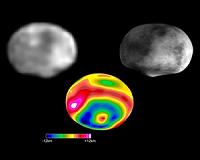 A Look Into Vesta's Interior
Katlenburg-Lindau, Germany (SPX) Jan 07, 2011 Researchers from the University of North Dakota and from the Max Planck Institute for Solar System Research in Germany have discovered a new kind of asteroid using NASA's Infrared Telescope Facility on Mauna Kea, Hawaii. The mineralogical composition of 1999 TA10 suggests that unlike many other asteroids it did not originate from the outer rocky crust of its parent asteroid Vesta, but from ... read more |
|
|
| The content herein, unless otherwise known to be public domain, are Copyright 1995-2010 - SpaceDaily. AFP and UPI Wire Stories are copyright Agence France-Presse and United Press International. ESA Portal Reports are copyright European Space Agency. All NASA sourced material is public domain. Additional copyrights may apply in whole or part to other bona fide parties. Advertising does not imply endorsement,agreement or approval of any opinions, statements or information provided by SpaceDaily on any Web page published or hosted by SpaceDaily. Privacy Statement |


 del.icio.us
 Digg
Digg Reddit
 YahooMyWeb
 Google
 Facebook


