|
 |
 |
 |
 |
 |
 |
 |
 |
 |

| . |  |
. |
NASA Sets Sights On First Pluto Mission
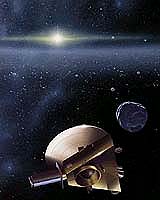
Laurel MD (SPX) Dec 20, 2005 NASA is preparing to launch the first spacecraft to distant Pluto and its moon Charon. The January 2006 launch of New Horizons will complete the initial reconnaissance of the planets in the solar system. "New Horizons will study a unique world, and we can only imagine what we may learn. This is a prime example of scientific missions that complement the Vision for Space Exploration," said Mary Cleave, associate administrator for NASA's Science Mission Directorate. The Vision for Space Exploration is a bold new course into the cosmos, a journey that will return the space shuttle safely to flight, complete the construction of the International Space Station, take humans back to the moon and eventually to Mars and beyond. The National Academy of Sciences has ranked the exploration of Pluto-Charon and the Kuiper Belt among the highest priorities for space exploration, citing the fundamental scientific importance of these bodies to advancing understanding of our solar system. Different than the inner, rocky planets (like Earth) or the outer gas giants, Pluto is a different type of planet known as an "ice dwarf," commonly found in the Kuiper Belt region billions of miles from the sun. "Exploring Pluto and the Kuiper Belt is like conducting an archeological dig into the history of the outer solar system, a place where we can peek into the ancient era of planetary formation," said Alan Stern, New Horizons principal investigator, Southwest Research Institute Department of Space Studies, Boulder, Colo. Designed and built at the Johns Hopkins University Applied Physics Laboratory, Laurel, Md., pending launch approval, New Horizons is set to launch from Cape Canaveral Air Force Station, Fla., no earlier than Jan. 17, 2006. The launch window extends until Feb. 14, 2006. The compact, 1,050-pound piano-sized probe will launch aboard an Atlas V expendable launch vehicle, followed by a boost from a kick-stage solid propellant motor. New Horizons will be the fastest spacecraft ever launched, reaching lunar orbit distance in just nine hours and passing Jupiter 13 months later. Launch before Feb. 3 allows New Horizons to fly past Jupiter in early 2007 and use the planet's gravity as a slingshot toward Pluto. The Jupiter flyby trims the trip to Pluto by five years and provides opportunities to test the spacecraft's instruments and flyby capabilities on the Jupiter system. The New Horizons science payload, developed under direction of Southwest Research Institute, includes imaging infrared and ultraviolet spectrometers, a multi-color camera, a long-range telescopic camera, two particle spectrometers, a space-dust detector and a radio science experiment. The dust counter was designed and built by students at the University of Colorado, Boulder. Depending on its launch date, New Horizons could reach the Pluto system as early as mid-2015, conducting a five-month-long study possible only from the close-up vantage of a spacecraft. It will characterize the global geology and geomorphology of Pluto and Charon, map their surface compositions and temperatures, and examine Pluto's atmospheric composition and structure. New Horizons also will study the small moons recently discovered in the Pluto system. The spacecraft will "sleep" in electronic hibernation for much of the cruise to Pluto. Operators will turn off all but the most critical electronic systems and monitor the spacecraft once a year to check out critical systems, calibrate instruments and perform course corrections, if necessary. The spacecraft will send back a beacon signal each week to give operators an instant read on spacecraft health. The entire spacecraft, drawing electricity from a single radioisotope thermoelectric generator, operates on less power than a pair of 100-watt household light bulbs. Related Links SwRI Dept of Space Studies New Horizons Pluto at JHU SpaceDaily Search SpaceDaily Subscribe To SpaceDaily Express  Atlas 5 Launch Of Pluto Mission New Horizions Delayed Five Days
 Cape Canaveral FL (SPX) Dec 18, 2005
NASA has delayed the launch of its mission to Pluto and the Kuipers beyond until January 17 to enable additional inspections of the Lockheed Martin built EELV class Atlas 5 rocket. |
|
|

| The content herein, unless otherwise known to be public domain, are Copyright 1995-2006 - SpaceDaily.AFP and UPI Wire Stories are copyright Agence France-Presse and United Press International. ESA PortalReports are copyright European Space Agency. All NASA sourced material is public domain. Additionalcopyrights may apply in whole or part to other bona fide parties. Advertising does not imply endorsement,agreement or approval of any opinions, statements or information provided by SpaceDaily on any Web page published or hosted by SpaceDaily. Privacy Statement |