
 |
 |
 |
 |
 |
 |
 |
 |
 |
 |

| . |  |
. |

Huntsville AL (JPL) Feb 10, 2011 NASA is about to discover how solar heat devours a comet. "For the first time, we'll see the same comet before and after its closest approach to the sun," explains Joe Veverka, principal investigator for NASA's Stardust-NExT mission. The comet is Tempel 1, which NASA's Deep Impact probe visited in 2005. Now another NASA spacecraft, Stardust-NExT, is closing in for a second look on Valentine's Day, Feb. 14, 2011. The two visits bracket one complete orbit of the comet around the sun--and a blast of solar heat. "Close encounters with the sun never go well for a comet," says Veverka. "Fierce solar heat vaporizes the ices in the comet's core, causing it to spit dust and spout gas. The cyclic loss of material eventually leads to its demise." Researchers suspect the flamboyant decay doesn't happen evenly all over a comet's surface*, but until now they've lacked a way to document where, exactly, it does occur. Stardust NExT will image some of the same surface areas Deep Impact photographed 6 years ago, revealing how these areas have changed and where material has been lost. "Deep Impact gave us tantalizing glimpses of Temple 1," says Veverka. "And we saw strange and unusual things we'd like a closer look at." At a January 2011 press conference, Veverka and other Stardust-NExT team members listed the features they're most interested in seeing again: For starters, parts of the comet's surface are layered like pancakes. "Earth has layers because water and wind move dirt and debris around here, but layering on a comet was a surprise - and a mystery," says Veverka. "One idea is that two protocometary bodies collided at low speeds and smushed together to form something like a stack of flapjacks," says Pete Shultz, Stardust-NExT co-investigator. Is that right? Data obtained by Stardust-NExT will provide clues and possibly reveal what made the "comet pancakes." Another area intrigues the research team even more. "There's a large plateau that looks like a flow," says Shultz. "If it really is a flow, it means there was recently gas and dust emanating from the [surface]." Stardust-NExT will reveal how the plateau has changed (Is it flowing?), helping the team determine its origin. Whatever their origin, the plateau and layering show that comets have a much more complicated geologic history than previously thought. "Tempel 1 is not just a fuzzy ball," says Shultz. "It has history." It's a history NASA has had a hand in. During its 2005 visit, Deep Impact dropped an 820-pound projectile into the comet's core. In a development that surprised mission scientists, the impact excavated so much material that the underlying crater was hidden from view. Deep Impact's cameras were unable to see through the enormous cloud of dust the impactor had stirred up. Stardust NExT could provide a long anticipated look at the impact site. "The dust has settled there, so if the right part of the comet is facing us, we could see the crater and learn its size," says Veverka. "That would answer some key questions. For instance, is a comet's surface hard or soft?" In a future mission, a spacecraft may land on a comet and gather samples for analysis. To design a suitable lander, researchers need to know what kind of surface it would land on. They'll also need to know which tools to send - drills for hard surfaces or scoops for something softer. Like Deep Impact, the Stardust spacecraft has already had a productive career. Launched in 1999, it approached Comet Wild 2 close enough in 2004 to image its feature-rich surface and even gather dust particles from the comet's atmosphere. (A key finding in the sample was the amino acid glycene - a building block of life.) "We could have just let this old spacecraft rest on those laurels, leaving it to forever orbit the sun," says Veverka. "But instead, we're doing first-class comet science with it - again." As for Tempel 1, a hungry sun awaits.
Share This Article With Planet Earth
Related Links Star Dust Next Misson at JPL Asteroid and Comet Mission News, Science and Technology

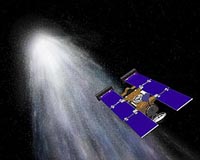 Stardust Celebrates Twelve Years With Rocket Burn
Pasadena CA (JPL) Feb 09, 2011 NASA's Stardust spacecraft marked its 12th anniversary in space on Monday, Feb. 7, with a rocket burn to further refine its path toward a Feb. 14 date with a comet. The half-minute trajectory correction maneuver, which adjusts the spacecraft's flight path, began at about 1 p.m. PST (4 p.m. EST) on Monday, Feb. 7. The 30-second-long firing of the spacecraft's rockets consumed about 69 ... read more |
|
|
| The content herein, unless otherwise known to be public domain, are Copyright 1995-2010 - SpaceDaily. AFP and UPI Wire Stories are copyright Agence France-Presse and United Press International. ESA Portal Reports are copyright European Space Agency. All NASA sourced material is public domain. Additional copyrights may apply in whole or part to other bona fide parties. Advertising does not imply endorsement,agreement or approval of any opinions, statements or information provided by SpaceDaily on any Web page published or hosted by SpaceDaily. Privacy Statement |


 del.icio.us
 Digg
Digg Reddit
 YahooMyWeb
 Google
 Facebook


