|
 |
 |
 |
 |
 |
 |
 |

| . |  |
. |

|
|
. |

 by Staff Writers Washington DC (SPX) Jun 17, 2011
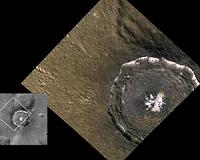
NASA scientists are making new discoveries about the planet Mercury. Data from MESSENGER, the first spacecraft to orbit Mercury, is giving scientists important clues to the origin of the planet and its geological history and helping them better understand its dynamic interior and exterior processes. NASA's MErcury Surface, Space ENvironment, GEochemistry, and Ranging spacecraft, or MESSENGER, has been orbiting Mercury since March 18. To date the spacecraft has provided tens of thousands of images showing detailed planetary features. The planet's surface previously had been seen only at comparatively low resolution but is now in sharper focus. The spacecraft also has collected extensive measurements of the chemical composition of Mercury's surface and topography and gathered global observations of the planet's magnetic field. Data now confirm that bursts of energetic particles in Mercury's magnetosphere are a continuing product of the interaction of Mercury's magnetic field with the solar wind. "We are assembling a global overview of the nature and workings of Mercury for the first time," said MESSENGER principal investigator Sean Solomon of the Carnegie Institution of Washington. "Many of our earlier ideas are being cast aside as new observations lead to new insights. Our primary mission has another three Mercury years to run, and we can expect more surprises as our solar system's innermost planet reveals its long-held secrets." Flyby images of Mercury had detected bright, patchy deposits on some crater floors. Without high-resolution images to obtain a closer look, these features remained only a curiosity. Now new detailed images have revealed these patchy deposits to be clusters of rimless, irregular pits varying in size from several hundred feet to a few miles wide. These pits are often surrounded by diffuse halos of more reflective material and are found on central peaks, peak rings, and rims of craters. "The etched appearance of these landforms is unlike anything we've seen before on Mercury or the moon," said Brett Denevi, a staff scientist at the Johns Hopkins University Applied Physics Laboratory (APL) in Laurel, Md., and a member of the MESSENGER imaging team. "We are still debating their origin, but they appear to be relatively young and may suggest a more abundant than expected volatile component in Mercury's crust." One of two instruments on the spacecraft designed to measure the quantity of key chemical elements on Mercury has made several important discoveries since the orbital mission began. Elemental ratios averaged over large areas of the planet's surface show that Mercury's surface differs markedly in composition from that of the moon. Observations have revealed substantial amounts of sulfur at Mercury's surface, lending support to prior suggestions from ground-based telescopic observations that sulfide minerals are present. This discovery suggests that the original building blocks from which Mercury formed may have been less oxidized than those that formed the other terrestrial planets. The result also hints that sulfur-containing gases may have contributed to past explosive volcanic activity on Mercury. Topography data of Mercury's northern hemisphere reveal the planet's large-scale shape and profiles of geological features in high detail. The north polar region is a broad area of low elevations, whereas the overall range in topographic heights seen to date exceeds 5 miles (9 kilometers). Two decades ago, Earth-based radar images showed deposits thought to consist of water ice and perhaps other ices near Mercury's north and south poles. These deposits are preserved on the cold, permanently shadowed floors of high-latitude impact craters. MESSENGER is testing this idea by measuring the floor depths of craters near Mercury's north pole. The craters hosting polar deposits appear to be deep enough to be consistent with the idea that those deposits are in permanently shadowed areas. During the first of three Mercury flybys in1974, Mariner 10 discovered bursts of energetic particles in the planet's Earth-like magnetosphere. Four bursts of particles were observed on that flyby. Scientists were puzzled that no such strong events were detected by MESSENGER during any of its three flybys of the planet in 2008 and 2009. But now that the spacecraft is in near-polar orbit around Mercury, energetic events are being seen regularly. The spacecraft was designed and built by APL. The lab manages and operates the mission for NASA's Science Mission Directorate (SMD) in Washington. The mission is part of NASA's Discovery Program, managed for SMD by the agency's Marshall Space Flight Center in Huntsville, Ala.
|
. |
|
| The content herein, unless otherwise known to be public domain, are Copyright 1995-2011 - Space Media Network. AFP and UPI Wire Stories are copyright Agence France-Presse and United Press International. ESA Portal Reports are copyright European Space Agency. All NASA sourced material is public domain. Additional copyrights may apply in whole or part to other bona fide parties. Advertising does not imply endorsement,agreement or approval of any opinions, statements or information provided by Space Media Network on any Web page published or hosted by Space Media Network. Privacy Statement |

 del.icio.us
 Digg
Digg Reddit
 Google