
 |
 |
 |
 |
 |
 |
 |
 |
 |
 |

| . |  |
. |

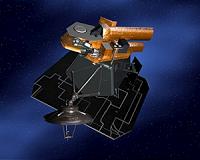
Pasadena CA (JPL) Oct 29, 2010 In one of its final mission trajectory correction maneuvers, the EPOXI mission spacecraft has refined its orbit, preparing it for the flyby of comet Hartley 2 on Nov. 4. The time of closest approach to the comet on that day is expected to be about 7:02 a.m. PDT (10:02 a.m. EDT). Today's trajectory correction maneuver began at 11 a.m. PDT (2 p.m. EDT), when the spacecraft burned its engines for 60 seconds, changing its velocity by 1.59 meters per second (3.6 miles per hour). On Nov. 4, the spacecraft will fly past Hartley 2 at a distance of about 700 kilometers (435 miles). It will be only the fifth time in history that a spacecraft has been close enough to image a comet's nucleus.
earlier related report "Hartley 2 has already put on a great show with more than a few surprises for the mission's science team," said EPOXI principal investigator Mike A'Hearn from the University of Maryland, College Park. "We expect more of the unexpected during encounter." Science observations of comet Hartley 2 began on Sept. 5. The imaging campaign is more than a tantalizing tease of things to come. It is providing EPOXI's science team the best extended view of a comet in history during its pass through the inner solar system. The observations will continue through the encounter phase of the mission. The hours surrounding comet encounter will be especially challenging for the mission team as they are commanding a recycled spacecraft that was not designed for this comet flyby. The spacecraft was designed and employed successfully for NASA's Deep Impact encounter of comet Tempel 1 back on July 4, 2005. By recycling Deep Impact's already built, tested and in-flight spacecraft, the EPOXI mission provided savings on the order of 90% that of a hypothetical mission with similar goals, starting from the ground up. "If we were starting from scratch we'd probably move some of the spacecraft's components to different locations," said Tim Larson, project manager for the EPOXI mission from NASA's Jet Propulsion Laboratory in Pasadena, Calif. "But we've developed a creative way to work with what we have. This spacecraft, and mission team, have logged 3.2 billion miles over the past five years, and we are confident that we have a successful plan in place to give Hartley 2 a thorough look-see." The mission's encounter phase begins the evening of Nov. 3, when the spacecraft is about 18 hours from the time of closest approach to the comet's nucleus. At that time the spacecraft will stop transmitting through its large high-gain antenna and reorient itself so its two visible-light and one infrared imager maintain lock on the comet for the next 24 hours-plus. "When the encounter phase begins all images the spacecraft takes will be stored aboard its two computers," said Larson. "Soon after we fly past the comet at about 7 a.m. local time, we will be able to re-orient the spacecraft so that we maintain imaging lock on the comet nucleus while pointing our big high gain antenna at Earth." At that point, the spacecraft will begin beaming down its cache of cometary close-ups while continuing to take new images. It is expected to take several hours for all the images held aboard spacecraft memory to be downliked. "We will be waiting," said A'Hearn. "The images at closest approach won't get to Earth until many hours after the actual encounter due to the way we use memory on the spacecraft. We will get some early hints at how this nucleus differs from that of comet Tempel 1 based on five images that will get to Earth only about one hour after closest approach."
Share This Article With Planet Earth
Related Links EPOXI Asteroid and Comet Mission News, Science and Technology

 Countdown To Comet Flyby Down To Nine Days
Pasadena CA (SPX) Oct 27, 2010 NASA's EPOXI mission continues to close in on its target, comet Hartley 2, at a rate of 12.5 kilometers (7.8 miles) per second. On Nov. 4 at about 10:01 a.m. EDT (7:01 a.m. PDT) the spacecraft will make its closest approach to the comet at a distance of about 700 kilometers (434 miles). It will be the fifth time that a comet has been imaged close-up and the first time in history that two c ... read more |
|
|
| The content herein, unless otherwise known to be public domain, are Copyright 1995-2010 - SpaceDaily. AFP and UPI Wire Stories are copyright Agence France-Presse and United Press International. ESA Portal Reports are copyright European Space Agency. All NASA sourced material is public domain. Additional copyrights may apply in whole or part to other bona fide parties. Advertising does not imply endorsement,agreement or approval of any opinions, statements or information provided by SpaceDaily on any Web page published or hosted by SpaceDaily. Privacy Statement |


 del.icio.us
 Digg
Digg Reddit
 YahooMyWeb
 Google
 Facebook


