
 |
 |
 |
 |
 |
 |
 |
 |
 |
 |

| . |  |
. |
NASA Spacecraft Ready To Explore Outer Solar System
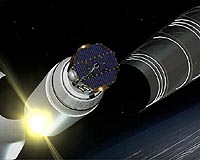
Washington DC (SPX) Oct 07, 2008 The first NASA spacecraft to image and map the dynamic interactions taking place where the hot solar wind slams into the cold expanse of space is ready for launch Oct. 19. The two-year mission will begin from the Kwajalein Atoll, a part of the Marshall Islands in the Pacific Ocean. Called the Interstellar Boundary Explorer or IBEX, the spacecraft will conduct extremely high-altitude orbits above Earth to investigate and capture images of processes taking place at the farthest reaches of the solar system. Known as the interstellar boundary, this region marks where the solar system meets interstellar space. "The interstellar boundary regions are critical because they shield us from the vast majority of dangerous galactic cosmic rays, which otherwise would penetrate into Earth's orbit and make human spaceflight much more dangerous," said David J. McComas, IBEX principal investigator and senior executive director of the Space Science and Engineering Division at the Southwest Research Institute in San Antonio. The story of the outer solar system began to unfold when the Voyager 1 and Voyager 2 spacecrafts left the inner solar system and headed out toward the boundary between our solar system and interstellar space. "The Voyager spacecraft are making fascinating observations of the local conditions at two points beyond the termination shock that show totally unexpected results and challenge many of our notions about this important region," said McComas. Other spacecraft have continued the exploration of the interstellar boundary region. Recently, a pair of NASA sun-focused satellites, the Solar Terrestrial Relations Observatory mission, detected a higher-energy version of the particles IBEX will observe in the heliosphere. The heliosphere is an area that contains the solar wind. It stretches from the sun to a distance several times the orbit of Pluto. IBEX is poised to thoroughly map this interstellar boundary region of the solar system. The images will allow scientists to understand the global interaction between our sun and the galaxy for the very first time. IBEX will be launched aboard a Pegasus rocket dropped from under the wing of an L-1011 aircraft flying over the Pacific Ocean. The Pegasus will carry the spacecraft approximately 130 miles above Earth and place it in orbit. "What makes the IBEX mission unique is that it has an extra kick during launch," said Willis Jenkins, IBEX program executive at NASA Headquarters in Washington. "An extra solid-state motor pushes the spacecraft further out of low-Earth orbit where the Pegasus launch vehicle leaves it." The IBEX mission is the next in NASA's series of low-cost, rapidly developed Small Explorers spacecraft. NASA's Goddard Space Flight Center in Greenbelt, Md., manages the Explorers Program for NASA's Science Mission Directorate in Washington. The mission was developed by Southwest Research Institute with national and international partner participation. Community Email This Article Comment On This Article Share This Article With Planet Earth
Related Links IBEX mission The million outer planets of a star called Sol
 Dawn Reaches It's First Anniversary
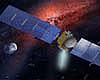 Los Angeles CA (SPX) Oct 01, 2008
On the first anniversary of its departure from Earth, Dawn continues with what it has been doing for most of its time in space: with the greatest patience it is gently reshaping its orbit around the Sun with its ion propulsion system. |
|
|

| The content herein, unless otherwise known to be public domain, are Copyright 1995-2007 - SpaceDaily.AFP and UPI Wire Stories are copyright Agence France-Presse and United Press International. ESA Portal Reports are copyright European Space Agency. All NASA sourced material is public domain. Additional copyrights may apply in whole or part to other bona fide parties. Advertising does not imply endorsement,agreement or approval of any opinions, statements or information provided by SpaceDaily on any Web page published or hosted by SpaceDaily. Privacy Statement |
 del.icio.us
 Digg
Digg Reddit
 YahooMyWeb
 Google
 Facebook