
. Military Space News .
NASA's Swift Satellite Images A Galaxy Ablaze With Starbirth

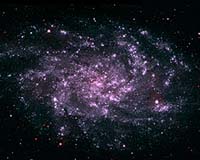
Image credit: NASA/Swift Science Team/Stefan Immler.
by Bob Naeye
Greenbelt MD (SPX) Feb 28, 2008
Imagine looking at a tree through eyeglasses that only allow red light to pass through. The tree is going to look a lot different than how it would look without the glasses. The same goes for a galaxy when astronomers look at it through different types of telescopes.

This new image from NASA's Swift satellite demonstrates what happens when astronomers look at a galaxy in ultraviolet light rather than the visible light that we see with our eyes. Swift took the image through a series of filters that only let in ultraviolet light. We cannot see ultraviolet light with our eyes, but we can feel its effects: it gives us sunburn if we stay out in the Sun too long on a bright, sunny day.

The Swift ultraviolet image shows the Triangulum Galaxy, so named because it resides in the northern constellation Triangulum. The galaxy is also known as M33, because it's the 33rd object in a catalog of sky objects that was assembled by French astronomer Charles Messier in the 1700s. The galaxy itself is about half the size of our Milky Way Galaxy, and is located about 2.9 million light-years from Earth. This means that it takes the light from M33 2.9 million years to reach Earth.

The image itself is actually a mosaic of 13 individual pictures that were taken between December 23, 2007 and January 4, 2008. Astronomer Stefan Immler of NASA's Goddard Space Flight Center used a computer to stitch the individual pictures into a seamless image. "This is the most detailed ultraviolet image of an entire galaxy ever taken," says Immler.

The image clearly shows the spiral structure of M33. New stars are forming inside the spiral arms. These stars are very hot, and give off a lot of ultraviolet light. This light hits nearby clouds of gas, heating them up and causing them to also shine in ultraviolet light.

"The ultraviolet colors of star clusters tell us their ages and compositions," says Swift team member Stephen Holland of NASA Goddard. "With Swift's high spatial resolution, we can zero in on the clusters themselves and separate out nearby stars and gas clouds. This will enable us to trace the star-forming history of the entire galaxy."

"The entire galaxy is ablaze with starbirth," adds Immler. "Despite M33's small size, it has a much higher star-formation rate than our Milky Way Galaxy. All of this starbirth lights up the galaxy in the ultraviolet."

Community
Email This Article
Comment On This Article

Related Links
the missing link Stellar Chemistry, The Universe And All Within It


Memory Foam Mattress Review
Newsletters :: SpaceDaily :: SpaceWar :: TerraDaily :: Energy Daily
XML Feeds :: Space News :: Earth News :: War News :: Solar Energy News


Powerful Explosions Suggest Neutron Star Missing Link
Greenbelt MD (SPX) Feb 22, 2008
Observations from NASA's Rossi X-ray Timing Explorer (RXTE) have revealed that the youngest known pulsing neutron star has thrown a temper tantrum. The collapsed star occasionally unleashes powerful bursts of X-rays, which are forcing astronomers to rethink the life cycle of neutron stars.


  • Atlantic Eye: President-to-be Obama
  • Pan-European defence too often lost in translation: ministers
  • India to host next military exercise with China: report
  • Outside View: Russia rearms

  • Israeli PM say Iran can be stopped from getting nuclear capacity
  • Rice urges China to use maximum influence on North Korea
  • Iran leader hails Ahmadinejad for 'nuclear success'
  • IAEA's credibility at stake: Iranian ambassador

  • India, Israel to jointly develop anti-aircraft missiles
  • Pakistan says Indian missile test to trigger arms race: report
  • India test-fires sea-based nuclear-capable missile: ministry
  • AIM-9X Enters The US Navy's Weapons System User Program

  • US offers Poland military plan for missile shield: ministry
  • US, Czech on cusp of missile shield deal
  • Czech PM in US touts missile shield plan
  • Czech, Poland close to deal on US anti-missile shield: officials

  • Environmentalists climb on Heathrow jet in airport protest: officials
  • NASA opens a rotary wing research project
  • All-star line-up at first Singapore Airshow
  • Military Aircraft To Perform Aviation Safety Research

  • QinetiQ Selects Aonix PERC For Taranis UAV
  • Autonomous Technology Is Cool For CATS
  • Assembly Starts Of Taranis Unmanned Combat Air Vehicle
  • Boeing-Insitu ScanEagle UAV Achieves 10,000 Flight Hours In Support Of Australian Army Operations

  • Feature: Coalition, al-Qaida set stage
  • British watchdog orders gov't to release Iraq war documents
  • 140,000 US troops to remain in Iraq: Pentagon
  • Thompson Files: Obama is tough

  • Lockheed Martin MULE Program Begins Work On Final System Design
  • DRS To Demonstrate Advanced EO/IR Sensors And Systems
  • Raytheon's Miniature Air Launched Decoy Completes Flight Testing
  • Lockheed Martin Demonstrates Two-Way Video Datalink For Sniper Advanced Targeting Pod

  • The content herein, unless otherwise known to be public domain, are Copyright 1995-2007 - SpaceDaily.AFP and UPI Wire Stories are copyright Agence France-Presse and United Press International. ESA Portal Reports are copyright European Space Agency. All NASA sourced material is public domain. Additional copyrights may apply in whole or part to other bona fide parties. Advertising does not imply endorsement,agreement or approval of any opinions, statements or information provided by SpaceDaily on any Web page published or hosted by SpaceDaily. Privacy Statement