
 |
 |
 |
 |
 |
 |
 |
 |
 |
 |

| . |  |
. |
NASA's Swift Spies Comet Lulin
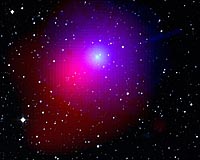
Pasadena CA (SPX) Feb 24, 2009 While waiting for high-energy outbursts and cosmic explosions, NASA's Swift Gamma-ray Explorer satellite is monitoring Comet Lulin as it closes on Earth. For the first time, astronomers are seeing simultaneous ultraviolet and X-ray images of a comet. "We won't be able to send a space probe to Comet Lulin, but Swift is giving us some of the information we would get from just such a mission," said Jenny Carter, at the University of Leicester, U.K., who is leading the study. "The comet is releasing a great amount of gas, which makes it an ideal target for X-ray observations," said Andrew Read, also at Leicester. A comet is a clump of frozen gases mixed with dust. These "dirty snowballs" cast off gas and dust whenever they venture near the sun. Comet Lulin, which is formally known as C/2007 N3, was discovered last year by astronomers at Taiwan's Lulin Observatory. The comet is now faintly visible from a dark site. Lulin will pass closest to Earth - 38 million miles, or about 160 times farther than the moon - late on the evening of Feb. 23 for North America. On Jan. 28, Swift trained its Ultraviolet/Optical Telescope (UVOT) and X-Ray Telescope (XRT) on Comet Lulin. "The comet is quite active," said team member Dennis Bodewits, a NASA Postdoctoral Fellow at the Goddard Space Flight Center in Greenbelt, Md. "The UVOT data show that Lulin was shedding nearly 800 gallons of water each second." That's enough to fill an Olympic-size swimming pool in less than 15 minutes. Swift can't see water directly. But ultraviolet light from the sun quickly breaks apart water molecules into hydrogen atoms and hydroxyl (OH) molecules. Swift's UVOT detects the hydroxyl molecules, and its images of Lulin reveal a hydroxyl cloud spanning nearly 250,000 miles, or slightly greater than the distance between Earth and the moon. The UVOT includes a prism-like device called a grism, which separates incoming light by wavelength. The grism's range includes wavelengths in which the hydroxyl molecule is most active. "This gives us a unique view into the types and quantities of gas a comet produces, which gives us clues about the origin of comets and the solar system," Bodewits explains. Swift is currently the only space observatory covering this wavelength range. In the Swift images, the comet's tail extends off to the right. Solar radiation pushes icy grains away from the comet. As the grains gradually evaporate, they create a thin hydroxyl tail. Farther from the comet, even the hydroxyl molecule succumbs to solar ultraviolet radiation. It breaks into its constituent oxygen and hydrogen atoms. "The solar wind - a fast-moving stream of particles from the sun - interacts with the comet's broader cloud of atoms. This causes the solar wind to light up with X rays, and that's what Swift's XRT sees," said Stefan Immler, also at Goddard. This interaction, called charge exchange, results in X-rays from most comets when they pass within about three times Earth's distance from the sun. Because Lulin is so active, its atomic cloud is especially dense. As a result, the X-ray-emitting region extends far sunward of the comet. "We are looking forward to future observations of Comet Lulin, when we hope to get better X-ray data to help us determine its makeup," noted Carter. "They will allow us to build up a more complete 3-D picture of the comet during its flight through the solar system." Other members of the team include Michael Mumma and Geronimo Villanueva at Goddard. NASA's Goddard Space Flight Center in Greenbelt, Md., manages the Swift satellite. It is being operated in collaboration with partners in the U.S., the United Kingdom, Italy, Germany and Japan. NASA's Fermi Gamma-ray Space Telescope is an astrophysics and particle physics observatory developed in collaboration with the U.S. Department of Energy and with important contributions from academic institutions and partners in France, Germany, Italy, Japan, Sweden, and the U.S. Share This Article With Planet Earth
Related Links Swift Gamma-ray Explorer Asteroid and Comet Mission News, Science and Technology
 How To See Comet Lulin As It Passes Earth
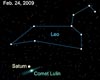 Center Harbor NH (SPX) Feb 24, 2009
This week a greenish, double-tailed smudgeball, named Comet Lulin for the Taiwanese observatory where it was discovered in July 2007, is passing its closest by Earth. You can spot it with a pair of binoculars. |
|
|

| The content herein, unless otherwise known to be public domain, are Copyright 1995-2007 - SpaceDaily.AFP and UPI Wire Stories are copyright Agence France-Presse and United Press International. ESA Portal Reports are copyright European Space Agency. All NASA sourced material is public domain. Additional copyrights may apply in whole or part to other bona fide parties. Advertising does not imply endorsement,agreement or approval of any opinions, statements or information provided by SpaceDaily on any Web page published or hosted by SpaceDaily. Privacy Statement |
 del.icio.us
 Digg
Digg Reddit
 YahooMyWeb
 Google
 Facebook
