. Military Space News .


.
ROCKET SCIENCE
NASA Will Compete Space Launch System (SLS) Boosters
by Launchspace Staff
for Launchspace
Bethesda MD (SPX) Jun 28, 2011

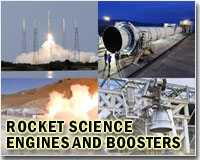
The booster competition will likely be between ATK and Aerojet. It appears that ATK will propose the five-segment version of the four-segment SRBs used on the Space Shuttle. The five-segment variant was to be the first stage of the Ares I crew launch vehicle.

It should come as no surprise that NASA has selected a "shuttle-derived" vehicle with two existing LOX/LH2 stages as its reference design for the new heavy-lift Space Launch System (SLS) ordered by Congress and to be used for exploration missions beyond low Earth orbit (LEO).

Over the past few years NASA had supported the use of solid rocket boosters (SRBs) as strap-on motors for both the now-cancelled Ares I and Ares V launch systems.

Many experts have opposed the use of SRBs for these applications, because of limited energy efficiency and expensive post-flight refurbishing. NASA has now decided to hold a competition between liquid-propellant and solid-propellant boosters for the SLS in order to satisfy a Congressional mandate.

The use of liquid-propellant boosters is not a new idea. The original proposed Space Shuttle design had included reusable fly-back liquid boosters as far back as the early 1970s.

Of course, the Shuttle system design was changed many times in the 1970s due to political and financial pressures. The end result was a lower cost development and higher per-flight costs for the Shuttle system.

Earlier this month, NASA Administrator Bolden endorsed the possible use of LOX/kerosene liquid boosters for SLS.

Such boosters could significantly increase the energy efficiency of the SLS boost phase and could allow this vehicle to offer a 130-metric-ton payload capability that is specified in the 2010 NASA reauthorization legislation.

The booster competition will likely be between ATK and Aerojet. It appears that ATK will propose the five-segment version of the four-segment SRBs used on the Space Shuttle. The five-segment variant was to be the first stage of the Ares I crew launch vehicle.

Aerojet will likely propose a U.S.-built version of the Russian-based NK-33, but renamed as the AJ-26.

Orbital Sciences will be using the AJ-26 as the main-stage engine for its new Taurus II commercial launch vehicle.

Launchspace speculates that had the liquid booster option been adopted for the original Space Shuttle, the U.S. might have saved several hundred million dollars and already have a working booster for SLS. Unfortunately, we will never know.


Related Links
Launchspace
Rocket Science News at Space-Travel.Com

.
Get Our Free Newsletters Via Email
...
Buy Advertising Editorial Enquiries


. Comment on this article via your Facebook, Yahoo, AOL, Hotmail login.

Share this article via these popular social media networks
del.icio.usdel.icio.us DiggDigg RedditReddit GoogleGoogle


ROCKET SCIENCE
Europe to build space re-entry vehicle
Paris (UPI) Jun 23, 2011
The European Space Agency says it is going ahead with its re-entry vehicle demonstrator, known as the IXV, which it expects to launch in 2013. The Intermediate Experimental Vehicle research craft will be launched to an altitude of 250 miles, where it will begin its re-entry through the atmosphere back to Earth, the BBC reported Thursday. A payload of sensors will record data on h ... read more


ROCKET SCIENCE
Raytheon gets $1.7 billion Patriot deal

Raytheon to Upgrade Patriot for Saudi Arabia

Yanukovych says 'no' to missile defense

Israelis brace for missiles, plan getaways

ROCKET SCIENCE
Iran fires medium-range missile in war game

Taiwan supersonic missile test flops

Raytheon Breaks Ground for Standard Missile Production Factory

Raytheon Delivers Patriot GEM-T Test Missiles for UAE

ROCKET SCIENCE
Iran says it showed Russia downed US drones

Boeing Receives UCLASS Study Contract from US Navy

Helicopter lost over Libya is new US drone: officials

Thales completes flight demo for automatic landing of rotary wing UAVs

ROCKET SCIENCE
Celebrating the 40th Anniversary of the Guardrail System

Russia launches Cosmos-series military satellite

US Army Builds and Tests Future Network During NIE Exercise

Spain aims at military-civilian satellites

ROCKET SCIENCE
Upgraded Puma Mk2 Helicopter for UK RAF Makes First Flight

HBC and ATK to Demonstrate Weapons System

Guns, grenades and iPads for Singapore soldiers

Northrop Grumman Demonstrates STARLite Radar on a US Army Persistent Threat Detection System

ROCKET SCIENCE
Australia plots biggest post-war military sale

The Russian Defence Market 2011-2021

Chavez's health an issue for arms deals

IAI gets new chief amid privatization bid

ROCKET SCIENCE
Outside View: Osama's perverted legacy

Walker's World: China's soft-power hurdle

NATO allies must pool funds or face decline: Gates

Ukraine secretly ramps up ties with NATO: report

ROCKET SCIENCE
System Integration of High Energy Laser Technology Demonstrator Completed

Raytheon Acquires Directed Energy Capabilities of Ktech Corporation

MLD Test Moves Navy A Step Closer To Lasers For Ship Self-Defense

US Navy And Northrop Grumman Accomplish Goals For At-Sea Demonstration Of Maritime Laser


Memory Foam Mattress Review
Newsletters :: SpaceDaily Express :: SpaceWar Express :: TerraDaily Express :: Energy Daily
XML Feeds :: Space News :: Earth News :: War News :: Solar Energy News
.

The content herein, unless otherwise known to be public domain, are Copyright 1995-2011 - Space Media Network. AFP and UPI Wire Stories are copyright Agence France-Presse and United Press International. ESA Portal Reports are copyright European Space Agency. All NASA sourced material is public domain. Additional copyrights may apply in whole or part to other bona fide parties. Advertising does not imply endorsement,agreement or approval of any opinions, statements or information provided by Space Media Network on any Web page published or hosted by Space Media Network. Privacy Statement