
 |
 |
 |
 |
 |
 |
 |
 |
 |
 |

| . |  |
. |
NASA launches telescope to seek Earth-like planets
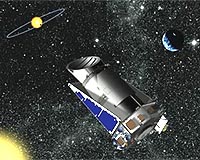
Washington (AFP) March 6, 2009 The United States late Friday launched a space telescope whose three-year mission is to find Earth-like planets in the Milky Way galaxy. The Kepler telescope blasted off from Cape Canaveral Air Force Station, Florida, atop a Delta II rocket 10:49 pm (0349 GMT Saturday), according to the US space agency NASA. "This mission attempts to answer a question that is as old as time itself -- are other planets like ours out there?" said Ed Weiler, associate administrator for NASA's Science Mission Directorate. "It's not just a science mission, it's an historical mission." Kepler will stare at the same spot in space for three and a half years, taking in about 100,000 stars around the Cygnus and Lyra constellations of the Milky Way. At a cost of nearly 600 million dollars, it will be the National Aeronautics and Space Administration's first mission in search of Earth-like planets orbiting suns similar to ours, at just the right distance and temperature for life-sustaining water to exist. The telescope will be hunting for relatively small planets that are neither too hot nor too cold, are rocky and have liquid water -- essential life-sustaining conditions -- explained William Borucki, Kepler's principal investigator based at NASA's Ames Research Center in California. "If we find that many, it certainly will mean that life may well be common throughout our galaxy, that there is an opportunity for life to have a place to evolve," Borucki said. Equipped with the largest camera ever launched into space -- a 95-megapixel array of charge-coupled devices (CCDs) -- the Kepler telescope is able to detect the faint, periodic dimming of stars that planets cause as they pass by. "If Kepler were to look down at a small town on Earth at night from space, it would be able to detect the dimming of a porch light as somebody passed in front," according to Kepler project manager James Fanson. This is no small feat. "Trying to detect Jupiter-size planets crossing in front of their stars is like trying to measure the effect of a mosquito flying by a car's headlight," Fanson said. "Finding Earth-sized planets is like trying to detect a very tiny flea in that same headlight." Kepler's discoveries "may fundamentally alter humanity's view of itself," Jon Morse, astrophysics division director at the NASA's Washington headquarters, told a press conference last month. "The planetary census Kepler takes will be very important for understanding the frequency of Earth-size planets in our galaxy and planning future missions that directly detect and characterize such worlds around nearby stars." Ever since astronomers first turned their telescopes to the sky, humans have been searching for other planets. But the small size of planets compared to stars has complicated the task. Only eight planets have been found in our solar system -- Pluto is now considered a mere planetoid. Since 1995, some 337 planets have been found orbiting around stars outside our solar system, but they are all bigger than Earth and do not have Earth-like conditions that make life possible. The French-led COROT satellite, which has been in orbit since 2006, has already discovered the smallest extraterrestrial planet so far. At a little over twice the Earth's diameter, the planet is very close to its star and very hot, astronomers reported earlier this month. Astronomer Debra Fischer at San Francisco State University said that NASA's mission is a cornerstone in understanding what types of planets are formed around other stars. Information that Kepler will help compile, she said, "will help us chart a course toward one day imaging a pale blue dot like our planet, orbiting another star in our galaxy." Share This Article With Planet Earth
Related Links Kepler at NASA Lands Beyond Beyond - extra solar planets - news and science Life Beyond Earth
 With March 6 Kepler Launch, Work Begins For Berkeley Astronomers
 Berkeley CA (SPX) Mar 05, 2009
When NASA's Kepler telescope rockets into the night sky on Friday, March 6, from Cape Canaveral Air Force Station in Florida, two University of California, Berkeley, astronomers - key members of the Kepler team - will be watching its fading contrail, hoping that the telescope will reveal Earth's and humanity's place in the universe. |
|
|

| The content herein, unless otherwise known to be public domain, are Copyright 1995-2007 - SpaceDaily.AFP and UPI Wire Stories are copyright Agence France-Presse and United Press International. ESA Portal Reports are copyright European Space Agency. All NASA sourced material is public domain. Additional copyrights may apply in whole or part to other bona fide parties. Advertising does not imply endorsement,agreement or approval of any opinions, statements or information provided by SpaceDaily on any Web page published or hosted by SpaceDaily. Privacy Statement |
 del.icio.us
 Digg
Digg Reddit
 YahooMyWeb
 Google
 Facebook