|
 |
 |
 |
 |
 |
 |
 |
 |
 |

| . |  |
. |
NASA pressed to avert catastrophic Deep Impact
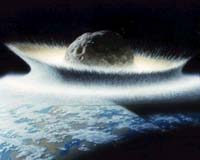
Washington (AFP) Nov 8, 2007 NASA penny-pinching risks exposing humankind to a planetary catastrophe if a big enough asteroid evades detection and slams into Earth, US lawmakers warned Thursday. But the US space agency said the chances of a new "Near-Earth Object" (NEO) like the one that wiped out the dinosaurs were too remote to divert scarce resources. Scott Pace, head of program analysis and evaluation at NASA, said the agency could not do more to detect NEOs "given the constrained resources and the strategic objectives NASA already has been tasked with." Pace and other NASA officials were grilled at a congressional hearing on the existing NEO program, which seized the public imagination in the late 1990s through the movies "Armageddon" and "Deep Impact." Lawmakers decried the threatened closure of a giant radio telescope in Puerto Rico run with NASA's assistance that is the world's foremost facility for tracking space objects. "We're talking about minimal expense compared to the cost of having to absorb this type of damage," Republican Congressman Dana Rohrabacher said. "After all, it may be the entire planet that is destroyed!" Puerto Rico delegate Luis Fortuno fretted over the economic impact on his impoverished US territory, but also warned of the broader consequences for the entire planet. "We must take action now to enhance our awareness to prevent a catastrophe," he told the hearing. The National Science Foundation has earmarked the Arecibo Observatory, which featured in science-fiction movie "Contact" and the James Bond installment "Goldeneye," for closure after 2011 if new private-sector money is not found. NASA officials said they would get by with new monitoring systems, including a network of four telescopes being built in Hawaii by the US Air Force. Critics say NASA has imposed big cuts on many research programs in a bid to meet President George W. Bush's goal of returning astronauts to the Moon by 2020 and use it as a stepping stone for manned missions to Mars and beyond. The hearing of the House of Representatives space and aeronautics subcommittee highlighted one small asteroid named Apophis, about 250 meters (273 yards) wide, which some scientists say could swing by Earth on Friday, April 13, 2029. NASA says there is a one in 45,000 chance that Apophis could pass through a "gravitational keyhole" and return to hit the planet in 2036. "It's a very unlikely situation and one we can drive to zero, probably," said Donald Yeomans, who manages the NEO program at NASA's Jet Propulsion Laboratory. NASA now only tracks NEOs larger than one kilometer (0.62 miles) in diameter, which come near Earth only once every few hundred thousand years. Objects of that size can cause global disaster through their immediate surface impact and by triggering rapid climate change. "Extinction-class" objects measuring at least 10 kilometers, such as the object that crashed into Mexico's Yucatan peninsula about 65 million years ago, would be rarer still. Lawmakers complained that NASA had failed to come up with a budget in line with a 2005 act of Congress that mandated an expanded search for NEOs that are at least 140 meters in diameter. The agency's annual NEO budget of 4.1 million dollars was attacked as being too meager to cover this goal. There are about 20,000 smaller objects with the potential to hit home, according to NASA, and Republican Representative Tom Feeney said "they could still inflict large regional impacts if they struck the Earth." Options to divert space rocks on a collision course with Earth include slamming nuclear missiles into them, although scientists believes that in most cases involving smaller debris, conventional rockets would do the job. Yeomans said also that while the European and Japanese space agencies are stepping up their own NEO programs, more than 98 percent of the work is now done by NASA. Community Email This Article Comment On This Article Related Links Asteroid and Comet Impact Danger To Earth - News and Science
 Outside View: Defending Earth -- Part 2
 Moscow (UPI) Oct 31, 2007
 Scientists say that after at least 90 percent of large asteroids are recorded and constantly observed, it will be possible to warn humankind about the threat of an impact some 80-100 years ahead. (Yury Zaitsev is an expert with the Russian Institute for Space Research. This article is reprinted by permission of RIA Novosti. The opinions expressed in this article are the author's and do not necessarily represent those of RIA Novosti.) |
|
|

| The content herein, unless otherwise known to be public domain, are Copyright 1995-2006 - SpaceDaily.AFP and UPI Wire Stories are copyright Agence France-Presse and United Press International. ESA PortalReports are copyright European Space Agency. All NASA sourced material is public domain. Additionalcopyrights may apply in whole or part to other bona fide parties. Advertising does not imply endorsement,agreement or approval of any opinions, statements or information provided by SpaceDaily on any Web page published or hosted by SpaceDaily. Privacy Statement |